The Role of Auto Spray Booths in Professional Car Painting

You step into an auto spray booth and see a clean, pressure-controlled space designed for painting cars. This environment keeps dust and moisture away from the car spray booth, so you get a smooth, professional finish. A spray paint booth protects your work by trapping fumes and keeping the air safe. The auto body spray booth uses special systems that help you work faster and safer. When you use a paint booth, you control the air and temperature to make every paint job look great.

Tip: A clean booth means fewer mistakes and better results.


Key Takeaways

  • Auto spray booths make a clean space for painting cars. They keep out dust and water. This helps the paint look smooth.
  • A spray booth makes work safer for people. It filters out bad fumes and chemicals. This keeps the air healthier.
  • There are different spray booths for different needs. Pick one that fits your shop size and budget. Think about the paint quality you want.
  • Using a spray booth well helps finish jobs faster. This makes customers happier and can bring in more money.
  • Using green methods in your spray booth helps the planet. It also helps you follow the rules.


What Is an Auto Spray Booth?

Economy Automotive Spray Paint Booth

Definition and Main Purpose

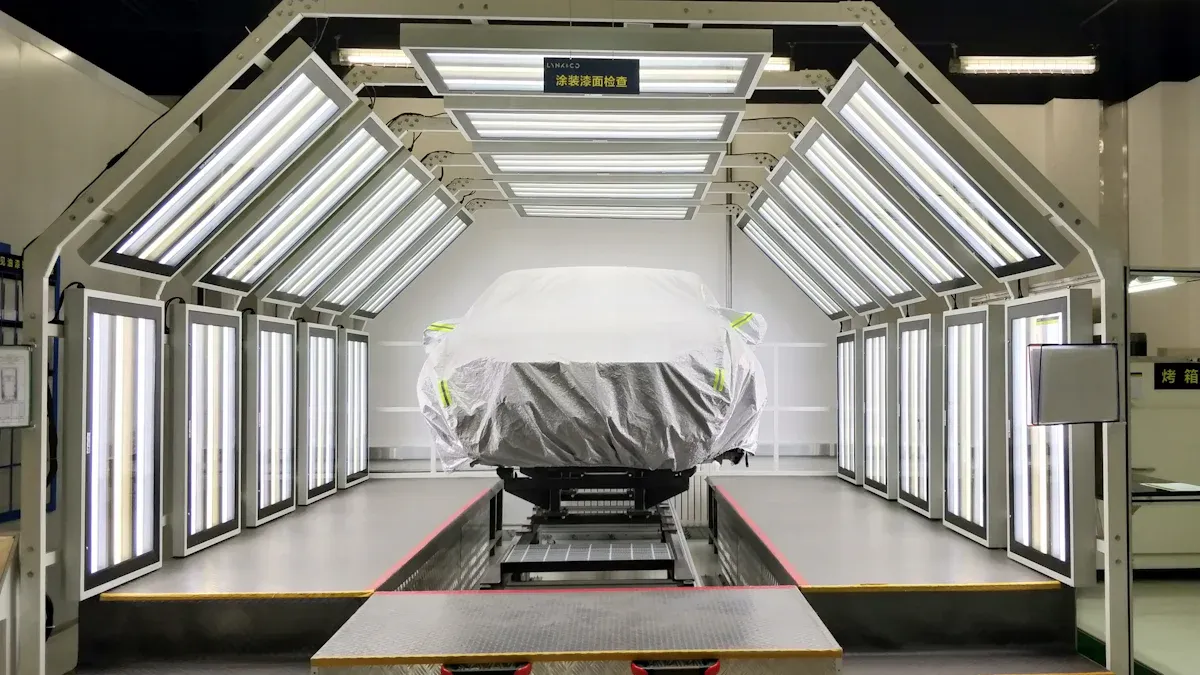
You use an auto spray booth to paint cars in a safe place. The auto spray booth is a closed room with controlled pressure. It is made for painting cars of any size. Most professional auto body shops have this space. It keeps dust, dirt, and water away from your work. This helps you get a smooth finish every time.

The main job of a car spray booth is to give you control. You can change the air, temperature, and humidity. This means you make fewer mistakes and get better results. The spray paint booth also keeps you safe from bad fumes. It makes the air safe for you and your team. You can work faster and safer because the booth controls extra paint and helps paint dry well.

Note: A clean and controlled booth gives better paint jobs and keeps everyone safe.


Here is a table that shows what a paint booth does:

Function

Description

Controlled Environment

Makes a space with less dust and dirt for good painting.

Management of Overspray

Stops extra paint and bad air from causing problems.

Filtration of Incoming Air

Cleans the air coming in so painting stays neat.

Ventilation

Removes bad fumes to keep workers safe.

Lighting

Gives bright light so you can see your work clearly.

Safety Features

Has systems to control air and keep workers safe.


How an Auto Spray Booth Works

When you use an auto body spray booth, you follow some steps. First, you clean the car to take off dust and grease. This makes the car ready for paint. Next, you put the car in the booth and close the doors. The booth uses fans and filters to bring in clean air and push out dirty air. This keeps dust and fumes away from your paint.

The auto body spray booth uses special ways to move air. These ways help get rid of extra paint and keep air moving right. Good air flow means less paint problems and a smoother finish. Bad air flow can cause dust or uneven shine on the car. The booth also has bright lights so you can see everything as you work.

Here are the main parts and steps in an auto body spray booth:

  • Cleaning Process: You clean the car to make it smooth.
  • Airflow Management: The booth moves air to keep dust away.
  • Filtration: Filters catch dust and paint bits.
  • Exhaust Fans: Fans balance air and remove fumes.
  • Duct-work: Pipes move air and fumes out.
  • Electrical Components: Safe lights help you see your work.

Tip: Always check the air flow and filters before painting. This helps you avoid problems and keeps you safe.


Types of Automotive Paint Booths

You can pick from many types of automotive paint booths. Each type has its own features, price, and good points. Some booths are best for small jobs. Others are made for big shops or lots of work.

Here is a table that compares the main types of spray booths:

Type of Paint Booth

Airflow Direction

Pros

Cons

Crossdraft Paint Booth

Horizontal

Cheap, easy to use

Hard to control extra paint

Downdraft Paint Booth

Downward

Great control, high quality

Costs more, needs more space

Side Downdraft Paint Booth

Downward along sides

Good air flow, fits small spaces

Not as good as full downdraft

Semi-Downdraft Paint Booth

Downward through center

Better air flow than crossdraft

Not all features included

Reverse Flow Paint Booth

Upward

Good for special needs

Not common, used for special jobs

Open-Face Paint Booth

None (open design)

Easy to use, good for small jobs

Bad control of extra paint

Enclosed Paint Booth

Enclosed

Keeps air clean, great for quality

Costs more, needs more space

Conveyorized Paint Booth

Automated conveyor system

Fast for lots of work

Harder to set up

You might use a crossdraft booth if you want a cheap option for simple jobs. If you need the best finish, you can choose a downdraft booth. For small jobs or moving work, a portable car spray booth is flexible. Each auto body spray booth helps you match your needs for price, speed, and quality.

Callout: Pick the right auto body spray booth based on your shop size, budget, and how good you want your paint job to be.


Key Benefits of Spray Paint Booths

Automotive Vehicle Spray Paint Booth

Clean and Consistent Paint Finish

You want every car to look great when it leaves. An auto spray booth helps you do this by keeping the area clean. The booth has a system that moves air in one way. This system takes away extra paint and dust in the air. Dust does not land on wet paint because the air stays clean.

A car spray booth uses strong filters to catch tiny dust. The closed booth keeps outside dirt and water away from your work. The inside walls stop dust from sticking. You work in special clean spots, so there is less chance for dirt. The booth controls heat and wetness in the air. This keeps dust from being a problem.

  • Airflow takes away dust and dirt.
  • Filters clean the air in steps.
  • Pressurized space keeps out outside dirt.
  • Special walls stop dust from sticking.
  • Clean spots protect your work.
  • Steady heat and wetness keep dust away.

Spray paint booths give you a space you can control. You do not have to worry about weather or outside dirt. You can focus on painting and get the same good results each time. There are different booth types, like cross-flow and downdraft. Downdraft booths are good for car painting because they keep dust away.

Tip: A clean booth means fewer paint problems and less fixing.


Worker Safety and Fume Control

You need to be safe when you paint cars. An auto body spray booth keeps you safe from bad fumes and chemicals. The booth has strong fans to move out bad air and bring in fresh air. This keeps the air safe and lowers the chance of fire.

Here is a table that shows health risks and how a spray booth helps:

Health Risks

Mitigation Strategies

Exposure to Toxic Chemicals

Use low-VOC paints and a good ventilation system.

Fire and Explosion Hazards

Advanced exhaust systems and following safety codes.

Inhalation of Dust and Particles

Enclosed booth with filters to trap dust.

Skin and Eye Exposure

Wear PPE and get proper training.

A car spray booth keeps bad fumes inside and stops them from spreading. You stay safe because the booth takes out dangerous chemicals. The closed booth and fans protect you from breathing in bad air. You also make fewer mistakes and follow safety rules. When you use an auto body spray booth, you work in a safe place.

Note: Always wear your gear and check the booth’s filters before you start.


Efficiency in Auto Body Shops

You want your shop to work well and finish jobs fast. An auto body spray booth helps you paint faster. The booth makes paint dry quicker and you do not have to fix as many mistakes. You spend less time fixing and more time painting new cars.

  • Closed booths help paint stick and look better.
  • Airflow keeps fumes under control.
  • Fewer mistakes mean less fixing.
  • Good results make customers happy and come back.
  • Faster work means you finish more jobs.

Here is a quick comparison:

Traditional Methods

With Paint Booths

5 jobs per day

7-8 jobs per day

More rework needed

Fewer mistakes

Lower revenue

Higher revenue

A portable car spray booth lets you do small jobs anywhere. You can move it and still get good results. The automotive paint booth helps you finish on time and keeps customers happy. The booth also traps bad fumes and dust, so you pollute less.

Callout: Using an auto body spray booth gives you better quality, more safety, and lets you finish more jobs each day.


Essential Features of Auto Body Spray Booths

Filtration and Airflow Systems

Clean air is important for a good paint job. The filtration system takes out dust, dirt, and fumes from the booth. This keeps your paint smooth and helps you stay healthy. Good filters also help you follow pollution rules. You can see how these systems help in the table below:

Role of Filtration and Airflow Systems

Description

Removal of Contaminants

Keeps air free of dust and debris for better paint finishes.

Worker Safety

Protects you from harmful fumes and particles.

Compliance with Regulations

Controls release of pollutants and VOCs.

You should use filters with a MERV rating of 11-16 or HEPA filters. These filters catch almost all tiny bits and stop paint problems.


Temperature and Humidity Control

You need to control heat and wetness for good painting. If the booth is too hot or cold, paint can peel or look rough. Too much wetness can make paint dry slow or look cloudy. The best heat for painting is between 70°F and 75°F. Keep wetness between 40% and 60%. This helps you get bright color and smooth paint.

  • Bad control can make paint dry uneven or change color.
  • Good heat and wetness help paint stick strong.
  • You stop drips, sags, and rough spots.


Lighting and Visibility

Bright light helps you see every part of the car. Good lights let you find mistakes and match colors. Pick white lights that are like daylight. LED lights are good because they save power and last long. The table below shows what to look for:

Lighting Requirement

Impact on Paint Quality

High-CRI (90+) lights

Accurate color rendering

Color temperature 5000K-6500K

True color perception

Brightness 1000–1500 lux

See texture and details clearly

Even light distribution

Fewer shadows, easier to spot imperfections

Tip: Good lights help you make fewer mistakes and fix less.


Heating and Curing Options

Heaters help paint dry and cure faster. This means you finish jobs quicker and work better. Heated booths keep the heat steady so paint dries even and sticks well. Direct-fired heaters save more power than other types. Some booths use heat recovery to save energy and cut pollution. When you control heat and air, you get strong paint and wait less.

Callout: Good heating and curing help you give cars tough, long-lasting paint.


Environmental Impact of Automotive Paint Booths

Emissions and Air Quality

When you paint cars in a spray booth, chemicals called VOCs go into the air. These chemicals can make the air inside and outside your shop dirty. VOCs come out when you paint and when the paint dries. If you breathe them in, your eyes, nose, or throat might hurt. Breathing these chemicals for a long time can hurt your kidneys, liver, or nerves. Some people can even get cancer from them. Modern booths use special filters and airflow systems to help. These systems catch paint bits and soak up bad VOCs before the air leaves the booth. This helps keep the air clean and safe for everyone.

  • VOCs go into the air during painting and drying.
  • Breathing them for a short time can make your eyes, nose, and throat hurt.
  • Breathing them for a long time can hurt your body and cause cancer.

Technology Type

Description

Airflow Design

Moves extra paint away from your work with special air.

Filtration Systems

Filters with many layers catch paint bits and clean the air.

Activated Carbon Filters

Soak up VOCs before air goes outside to keep people and nature safe.

Air Makeup Units (AMUs)

Bring in fresh air so the airflow stays the same.

Exhaust Stacks and Ducting

Let out clean air and stop bad fumes from building up.


Regulatory Compliance

You have to follow strict rules to keep your shop safe and protect the environment. Groups like OSHA and NFPA make these rules. You need to put labels on dangerous chemicals and teach workers how to be safe. Good ventilation is important, so you use strong exhaust fans. Fire safety matters, so you use special equipment that does not explode and sprinklers. You also wear safety gear to protect yourself. Your booth must be made from materials that do not burn and have strong exhaust systems. You change filters often and put up clear safety signs.

Regulatory Requirement

Description

OSHA Compliance

Put labels on chemicals and teach workers about safety.

NFPA Standards

Follow rules for spraying things that can catch fire.

Ventilation

Use exhaust fans to take out fumes.

Fire Safety Measures

Use gear that does not explode and sprinklers.

Personal Protective Equipment (PPE)

Wear safety gear to keep away chemicals.

You also keep records to show you follow the rules. You use spray guns and booths that meet new rules. You teach painters to use less paint and not waste it. You clean spray guns without spraying cleaner into the air.


Sustainable Practices

You can help the planet by using smart systems and new kinds of paint. Smart airflow and good heating systems use less energy. New booths need less power and water than old ones. Better filters cut down on VOCs and keep the air cleaner. You use lights that save energy and control airflow to use even less power. Systems that catch extra paint and recycle it help you make less waste. Waterborne and powder coatings are better for the earth. You meet tough rules by using paints with fewer emissions and by handling waste well. These steps help you work better and protect the planet.

  • Smart airflow systems use less energy.
  • Good heating systems save power.
  • Waterborne paints make less VOCs.
  • Better filters keep the air clean.
  • Energy-saving lights and airflow control use less power.
  • Catching and recycling extra paint makes less waste.
  • New water systems use less water.

Tip: When you use green practices, you work better and help the earth.


Auto spray booths help you get great paint jobs. They keep you safe and help you work faster. These booths also protect your health. You follow safety and environmental rules with special booth features. Here is how spray booths help you meet industry standards:

Aspect

Contribution to Standards

Safety Compliance

You follow OSHA and NFPA rules for a safer shop.

Environmental Responsibility

You use low-VOC paints and recycling to protect nature.

Efficiency Optimization

Automated systems help you work faster and waste less.

If you buy a modern spray booth, you get cleaner paint. You make fewer mistakes and finish jobs faster. You save money in the long run. Your customers stay happy with your work.


FAQ

What is the main purpose of an auto spray booth?

You use an auto spray booth to create a clean, safe space for painting cars. The booth keeps dust and fumes away from your work. This helps you get a smooth, professional finish every time.

How does a spray booth improve work efficiency?

A spray booth lets you control air, temperature, and humidity. You spend less time fixing mistakes. You finish more jobs each day. This boosts your work efficiency and helps your shop run better.

Do you need special training to use a spray booth?

Yes, you need training to use a spray booth safely. You learn how to handle paint, use safety gear, and follow rules. Training helps you avoid accidents and get better results.

Can a spray booth help protect the environment?

A spray booth uses filters and airflow systems to trap harmful chemicals. This keeps the air cleaner inside and outside your shop. You help protect the environment by using the booth the right way.

What types of filters do spray booths use?

Spray booths use different filters, such as pre-filters, HEPA filters, and carbon filters. These filters catch dust, paint particles, and fumes. You should check and change filters often for the best results.

Understanding the Benefits and Drawbacks of Different Automotive Spray Booth Types

When you pick an automotive spray booth, you control paint quality. You also help keep workers safe and manage costs. Clean spaces in new booths stop dust and dirt. This makes paint jobs look nicer. Most auto body shops use downdraft booths for trucks. The airflow and exhaust work well in these booths. Semi-downdraft booths save money and are easy to set up. Crossdraft booths cost less but need more work for great finishes. If you buy high-end booths, you can make more cars and get perfect results.


automotive spray booth


Key Takeaways

  • Pick a crossdraft booth if you want to save money. It is simple to set up. It works for many jobs. You might need to clean more to stop dust.
  • Choose downdraft booths for better paint finishes. They give great results. They cost more to install. They are harder to set up.
  • Side-draft booths have balanced airflow and keep you safe. They give good paint jobs. They need more room. They cost more money.
  • Semi-downdraft booths mix features from both types. They help you save money. They fit in small spaces.
  • Think about your shop’s needs and budget first. Look at the kind of work you do. Good airflow and cleaning help you get the best results.


Crossdraft Automotive Spray Booths

Overview

A crossdraft automotive spray booth has a simple airflow. Air comes in from the front of the booth. It goes through intake filters that catch dust and dirt. The air moves straight across the car or parts you paint. Then, it leaves through the back exhaust chamber. This chamber also has filters to trap paint overspray. The air always moves in one direction. This helps keep the booth clean inside. The exhaust filter is made with special glass fiber. This stops clogging and fogging. Clean air keeps flowing out of the booth.


Main Advantages

Crossdraft spray booths have many good points for your shop:

  • You can set up a crossdraft booth fast. You do not need a floor pit or a raised platform.
  • The price is lower than other paint booths. You save money when you buy and install it.
  • The booth is simple, so you pay less to run it. It does not need strong fans to move air.
  • The booth works quickly. It removes overspray and dirt fast. This helps you finish paint jobs sooner.
  • Crossdraft paint booths are good for many uses. Large paint booths like this can be used for painting cars, trucks, or large projects.
  • The airflow helps you get a smooth finish. You can give your customers great results.

Tip: If you want to save money and still get good quality, a crossdraft booth is a smart pick.


Large paint booths


Key Drawbacks

You should think about some problems before you pick a crossdraft booth:

  • The air moves sideways and can push dust onto the paint. This might hurt the finish.
  • You may need to work harder to keep the booth clean and control dust.
  • Crossdraft spray booths do not always meet the top safety rules for all jobs. Other booths can be safer.
  • The design is not best for shops that want perfect finishes or must follow strict safety codes.
  • If you want to save money and still get good work, crossdraft booths are a good choice. But you need to think about what your shop needs and how good you want your paint jobs to be.


Downdraft Automotive Paint Booths

Overview

A downdraft automotive spray booth uses a special way to move air. Air comes in from the whole ceiling through filters.

The air enters from the top and moves straight down. It goes over the car or truck and into the floor pit. The floor has grates, and air passes through them. The air then goes into an exhaust pit under the booth. This helps catch extra paint and keeps dust away. Downdraft booths use more than one filter. First, a pre-filter grabs big pieces of dirt. Next, a HEPA filter catches tiny dust and paint. The booth makes the air pressure lower inside. This keeps the air clean and the paint smooth.


Main Advantages

Downdraft paint booths give your shop many good things:

  • They control extra paint very well. Air moves down and takes away paint and dirt fast.
  • You get a great paint job. The booth removes dust right away. Your finish is smooth and even.
  • The air goes down and keeps your work area clean. You breathe better air, and fumes leave quickly.
  • You can use these booths for many jobs. They work for cars, trucks, and big projects.
  • Downdraft booths help you get great results. They keep your shop safe and clean.


Key Drawbacks

You should think about some problems before picking a downdraft booth:

  • It costs more to put in. You need a pit or basement for the exhaust.
  • The booth design is harder. You need special pipes and careful setup.
  • You must do regular checks. Filters need to be changed often to keep air moving well.
  • Downdraft booths cost more to install.
  • They are harder to build than other booths.
  • If you want the best paint and a clean shop, this booth is a good pick. You need to plan for the price and work, but the results are worth it.


Side-draft Spray Booths

Overview

You will find that a side-draft spray booth uses a unique airflow system. Air enters from the ceiling and moves sideways across the booth. The air then exits through exhaust filters on the walls. This design helps remove overspray and keeps energy use low. Unlike other types, such as crossdraft booths, side-draft booths give you more uniform airflow. You get better control over dust and paint particles. This means you can expect a cleaner space and a higher-quality finish.


Main Advantages

Side-draft spray booths offer several important benefits for your shop:

  • You get even airflow from top to sides. This helps you avoid runs or streaks in your paint.
  • The booth keeps harmful fumes and vapors away from you. Clean air flows past your work area and out through the walls.
  • The filtration system traps toxic chemicals. You stay safer and meet safety rules.
  • You can achieve a smooth, professional finish. The booth reduces dust and keeps the paint job consistent.
  • These booths work well for both large and small parts. You can use them for many automotive paint booth projects.

Note: A controlled painting environment helps you reach the best quality. You will see fewer defects and better results.


Key Drawbacks

You should know about some challenges with side-draft spray booths:

  • Height clearance can be a problem. If you work on large vehicles, you may not have enough space for proper coverage.
  • Not every automotive spray booth design fits all vehicles. Side-draft booths may not work well for trucks or buses with different shapes.
  • The cost to install a side-draft booth can be higher than basic models. You need to plan for this when choosing between booth types.
  • If you want a booth that balances safety, quality, and versatility, side-draft spray booths are a strong choice. Always match your booth to your shop’s needs for the best results.


Semi-downdraft Automotive Spray Booths

Overview

You will find that a semi-downdraft automotive spray booth blends features from both crossdraft and downdraft types. Air enters from the ceiling and one end of the booth. It then moves downward and across the work area, finally exiting through the floor and the opposite end. This airflow design helps remove overspray and fumes from your workspace. You get a balance between the strong downward air of a downdraft booth and the simple setup of a crossdraft booth. Many shops choose this style for medium-sized operations because it offers flexibility and good quality.


Main Advantages

You can enjoy several benefits when you pick a semi-downdraft automotive paint booth:

  • You save on cost since you do not need a deep pit for the exhaust system.
  • You can install this booth in places where a full downdraft booth will not fit, giving you more options for your shop layout.
  • You get flexibility to upgrade later, such as adding heated makeup air, without major changes.
  • The airflow helps keep your work area cleaner than a basic crossdraft booth.
  • Many spray booths of this type work well for both cars and trucks, making them a smart choice for growing shops.

Tip: If you want a booth that balances installation cost, safety, and finish quality, a semi-downdraft booth gives you strong value.


Key Drawbacks

You should know about some challenges with semi-downdraft spray booths:

The only downside of semi-downdraft paint booths is the potential for dead airflow spots at the front of the spray booth, along the floor. Dead spots, or areas where air does not flow properly over the product, can make spraying difficult even for the most skilled painter.

You may notice that these dead spots can affect the quality of your paint job. You might need to adjust your painting technique or booth setup to avoid uneven finishes. If you want the highest quality for every job, you should consider how airflow patterns in different spray booths can impact your results.


Comparing Automotive Spray Booth Types

Key Differences

When you look at spray booths, you see big differences. Each booth costs a different amount. Some are easy to set up, while others are harder. Air moves in different ways in each booth. The finish quality also changes with each type. Every booth works best for certain jobs in car and truck shops. You should check these things before you pick a booth for your shop.

Here is a table that shows the main features of each booth type:

Type of Booth

Airflow Pattern

Advantages

Disadvantages

Crossdraft

Air drawn from front to rear

Cost-effective, easy to install

May not provide best air quality

Semi-downdraft

Mix of crossdraft and downdraft

Improved airflow and paint quality

More expensive than crossdraft booths

Downdraft

Air drawn from ceiling to floor

Superior finish quality

Higher cost, complex installation

Side-downdraft

Air pulled from sides to floor

Balanced airflow and quality

Requires more space and investment

You can also see how finish quality compares across booth types:

Booth Type

Advantages

Limitations

Crossdraft

Economical, simple design, good for standard jobs

Limited contamination control, lower finish quality

Semi-downdraft

Better overspray control, good balance of cost/quality

Not as effective for high-end applications

Side-downdraft

Uniform airflow, higher quality finishes

Higher cost, not for all applications

Downdraft

Best airflow control, ideal for premium finishes

High initial and operational costs

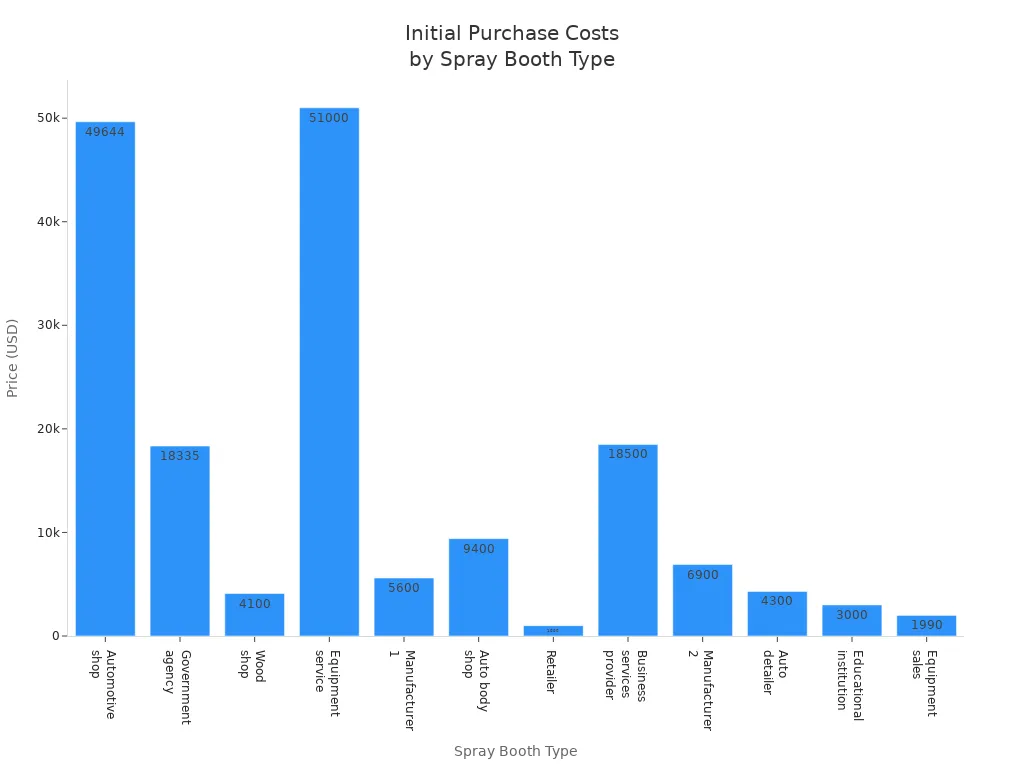
You should also think about how much each booth costs. The chart below shows how prices change with booth size and type:

Bar chart comparing initial purchase costs for different automotive spray booth types.

Downdraft booths use more energy because air moves from the top to the bottom. Side-downdraft booths use less energy and have good airflow. Crossdraft booths save money but may not save as much energy as downdraft booths.

You need to keep every booth clean. Clean your booth every day. Change filters often. Check the airflow to make sure it works right. Good filters and fans help stop dust and keep your shop safe.

NFPA and OSHA rules apply to all spray booths. Fully closed booths help you follow these rules and keep out dust. Always check your local rules before you buy a booth.


Choosing the Right Booth

Pick a booth that fits your shop’s needs. Here are some steps to help you choose:

  • Think about what you will paint. If you work on cars or trucks, you may need a big booth.
  • Look at your space. Make sure you have enough room for the booth and to work safely.
  • Set your budget. Crossdraft booths cost less, but downdraft and side-downdraft booths give better finishes.
  • Decide what finish you want. If you want a great paint job, pick a downdraft or side-downdraft booth.
  • Think about energy and running costs. Downdraft booths use more energy but give the best results.
  • Talk to a professional spray booth manufacturer. They can help you find the right booth and make sure you follow safety rules.

Tip: If your shop is small, a crossdraft booth is cheap and easy to put in. If you want the best results and have more money, pick a downdraft or side-downdraft booth.

Remember to keep your booth clean. Change filters often to keep it safe and working well. Good filters and fans protect your workers and your paint jobs.

Some shops forget to think about airflow or dust problems. Always pick a booth that fits your space, money, and quality needs. This helps you do the best work for your customers and your shop.


You can look at the table to find the main good and bad points for each spray booth type:

Booth Type

Pros

Cons

Crossdraft

Low price, simple to set up

More chance for dust

Downdraft

Best paint job, less dust

Costs more, harder to install

Side-draft

Air moves evenly, filters work well

Needs bigger space, costs more

Semi-downdraft

Good price and paint quality

Air might not move everywhere

Pick a booth that fits your shop’s size, money, and what you need to do. Good filters and airflow help stop mistakes and keep workers safe. Think about how your choice will help your shop work better for a long time.

Visit us at Automechanika Shanghai 2025, Booth No 6.2F38

Guangli is excited to announce our participation in Automechanika Shanghai 2025, happening from November 26 to 29, 2025, at the National Exhibition and Convention Center (Shanghai). As one of the leading automotive spray booth manufacturers, we invite all visitors, partners, and distributors to visit us at Booth No. 6.2F38 to explore our latest spray booth and 3D man lift innovations.


Booth No.: 6.2F38

Date: Nov. 26 – 29, 2025

Add: 333 Songze Avenue, Qingpu District, Shanghai, China.

Email: sunnie@gzguangli.com.cn

☎Call: +86 13925061383

Official website: https://www.gzguangli.com/


What We Will Showcase

As a leading automotive paint spray booth manufacturer in China, Guangli is dedicated to delivering the latest Chinese paint booth solutions that help our customers grow their business. Let’s take a quick look at what we will showcase at Automechanika Shanghai:

What is the Function of Automotive Paint Booths?

Being an automotive painter requires not only skills and knowledge, but also well-equipped spaces to carry out professional work according to client requests.


Automotive paint booths are completely enclosed, sealed, and overpressured enclosures through which hot air circulates at a speed suitable for painting and drying the paint applied to a vehicle in the shortest possible time. Automotive paint booths consist of the painting enclosure itself and the generator unit, with a hot air blower/burner, filters, and electronic controllers.

automotive paint booths

We'll tell you a little about the painting process and how a paint spray booth works. During paint application, the intake and exhaust turbines sweep clean air from the intake air internally. They eliminate dust particles as the clean air passes through the first filters, and then the clean air is sent to the top of the booth's plenum (ceiling). During the process, the interior of the booth will maintain overpressure at all times to prevent dust from entering.


As mentioned, car paint booths allow for greater time control, especially so that subsequent processes are more structured and the work area remains orderly.


To keep automotive paint booths in excellent condition, the following recommendations are available.

⦁ Always keep the booth floor clean before painting.

⦁ The vehicle must be clean.

⦁ It must be completely empty of hazardous and flammable items (gasoline from the vehicle's tank).

⦁ During painting, avoid entering and exiting the booth as much as possible to prevent dust from entering.

⦁ Before painting, check if there is diesel in the booth tank to prevent the burner from starting.

⦁ Workers must wear appropriate clothing and change their shoes before entering.

⦁ Smoking is strictly prohibited inside the paint booth.

⦁ Except for the spray gun and the water decanter, no other painting materials are allowed inside the booth.

⦁ Compressed air is used to clean the first filter meshes every 40 hours of operation.

⦁ Clean the filter meshes on the burner oil pipe injectors every month.

⦁ Change the plenum filters at the top of the booth periodically.


By following the tips below, you will always have a paint booth in optimal condition, which will ensure your facility lasts a long time, is competitive, and your paint jobs are perfect.

paint spray booth

What to Look for When Choosing an Automotive Spray Booth

When you pick an automotive spray booth, look at booth size, airflow, lighting, temperature control, and automation. Each part changes paint quality, shop safety, and how fast you work. For example, good airflow stops paint problems and helps you work faster. The table below shows how booth features change your results and safety:

Feature

Paint Quality

Safety

Efficiency

VOC Emission Control

Meets EPA rules

Lowers dangerous fumes

Cuts waste and helps you follow rules

Air Quality Protection

Smoother finish

Keeps workers safe from toxins

Makes the shop nicer to work in

Optimized Airflow

Fewer mistakes

Stops flammable vapor

Dries paint faster and lets you do more

Temperature and Humidity Control

Paint sticks better

Less chance of fire

Less waiting between coats

Pick booth size, airflow, and automation that fit your shop’s cars and work style for the best results.


Automotive Spray Booth Car Spray Paint Booth


Key Takeaways

  • Choose the right booth size for your vehicles. A proper fit allows for better airflow and safer working conditions.
  • Look for strong walls and doors. They protect your team and help maintain a safe working environment.
  • Select an efficient heating system. Direct fire heating is best for quick drying and energy savings.
  • Ensure good lighting in the booth. Bright, full-spectrum lights help you see details and avoid mistakes.
  • Regular maintenance is key. Clean filters and check equipment often to keep your booth running well.


Key Features of a Quality Paint Booth

Booth Size and Vehicle Fit

Booth size is very important when picking a paint booth. You need enough room for cars and workers to move. If the booth is too small, air does not flow well. This can make paint jobs worse. Workers need at least three feet around each car. This helps them work safely and quickly. Different cars need different booth sizes. The table below shows what size fits each type:

Vehicle Type

Interior Length (mm)

Interior Width (mm)

Interior Height (mm)

Sedan/Coupe/Hatchback

7,200

4,000

2,700

Large SUVs/Pickup Trucks

8,250

4,300

3,600

Trucks and Trailers

9,250

4,550

4,300

You can change booth size to fit your needs:

  • Most full-size cars need a booth at least 10 feet wide and 10 to 11 feet long.
  • Motorcycles or custom cars need a booth at least 16 feet wide and 5 to 6 feet deep.
  • Assembly lines work best with booths at least 6 feet wide and with adjustable length.
  • The right booth size helps you work faster and get better paint jobs. It also keeps your shop safe and stops delays.


Paint Booth Walls and Doors

Walls and doors keep your team and work safe in a paint booth. Strong walls last longer and protect everyone. The table below shows how wall materials change safety and durability:

Material

Influence on Durability

Influence on Safety

Galvanized Steel

Very strong and resists weather

Meets fire safety rules

Industrial PVC Coatings

Makes walls tough

Protects from chemicals

Dual Skin Non-Flammable Insulation

Stops heat from escaping

Lowers fire risk

Vinyl Coatings

Easy to clean and looks good

No glare and fewer hazards

You can pick different door styles for your booth. The right door makes it easy to move cars in and out. Here are some choices:

  • Swing doors open wide but need more space.
  • Multi-fold doors fit many booth sizes and seal tightly.
  • Roll-up doors save space and help with security.
  • RollSeal doors are quick to install and easy to use. Good walls and doors keep your shop safe and help you work better.


Automation and Heating Features

New spray booth technology gives you more control and saves energy. Automation lets you change temperature, humidity, and airflow. Smart sensors and robots help you use less paint and work more accurately. You can pick different automation options.

Heating systems are also important for paint booths. You want heat that works fast and stays steady. The table below shows two main heating systems:

Heating System Type

Efficiency

Key Features

Indirect Fire Heating

Up to 70%

Needs a chimney, reuses heat, loses some heat

Direct Fire Heating

Up to 90%

No chimney, recycles hot air, dries paint faster, saves energy

Direct fire heating works better. It heats up fast, saves energy, and keeps the booth warm. Keep the booth at least 70°F for good paint jobs. Some painters like 80-85°F for the best results. Automation and heating help you finish faster and save money.

Tip: For the best paint jobs, pick booths with AI or IoT systems. These let you control every part of painting and help you get perfect results.

A good paint booth lets you choose size, wall and door materials, and automation. Picking the right features makes your shop safer, helps you work faster, and gives you better paint jobs.


Airflow and Filtration in Automotive Spray Booths

Types of Airflow Systems

It is important to know how airflow systems work in a spray booth. There are three main types: downdraft, crossdraft, and semi-downdraft. Downdraft booths pull air from the top and push it out through the floor. This type gives you smooth finishes and better paint jobs. Crossdraft booths move air from one side to the other. These booths are good for small shops but can let paint mist move across the car. Semi-downdraft booths use both ways. Air moves at an angle, so it controls dirt better than crossdraft but is not as strong as downdraft.

Airflow System

Advantages

Disadvantages

Downdraft

Superior finish, excellent overspray control

Higher cost, needs more space

Crossdraft

Cost-effective, good for small shops

Risk of contamination, less overspray control

Semi-Downdraft

Economical, better airflow than crossdraft

Dead zone at front, less effective than downdraft


Importance of Laminar Airflow

Laminar airflow helps you get the same finish every time. Air moves in one direction and speed. This stops paint from swirling around. The steady air catches paint mist and takes away dirt in the air. You get a smooth coat on every car. Studies show laminar flow keeps air calm and stops random paint spots. This means you do not get bumps or rough spots and do not need to fix mistakes. Using more filters in the booth also helps paint stick better.

  • Laminar airflow makes a safe place for painting.
  • Turbulent airflow makes swirls and rough paint.
  • A booth with laminar airflow gives you better paint and less dirt.


Filtration and Air Intake Plenum

A good filtration system is important for safety and paint jobs. Air comes in through the air intake plenum, which spreads air evenly. Filters on the ceiling use layers to catch dust and dirt. HEPA filters trap almost all tiny bits and keep the air clean. As air moves out, exhaust filters catch paint mist and send it away from the booth. You should check and change filters often to keep air moving well and protect workers from bad fumes.

  • Intake and exhaust filters make air better and lower health risks.
  • Changing filters often helps the booth last longer and keeps paint even.
  • A good airflow and filtration system help you get smooth finishes and better paint jobs every time.


Lighting, Temperature, and Humidity Control

Optimal Lighting Features

Lighting shapes how well you see and paint inside an automotive spray booth. You need adequate lighting to spot every detail and match colors correctly. When you think about what to look for in paint booth lighting, focus on these points:

  • Use white, full spectrum lights. These lights show true colors and do not add any tint.
  • Place lights so every part of the car gets even light. This stops shadows and dark spots.
  • Choose lights with a Color Rendering Index (CRI) of 85 or higher. High CRI lights help you see colors as they really are.
  • Aim for 100-150 foot candles (about 1076 to 1614 lux) at three feet above the floor. This level lets you inspect and match colors well.
  • If you do not have enough light, you might miss small flaws or paint defects. You may not see issues like mottling or poor blending. The color temperature of your lights also matters. Light at 5000K helps you see true color. Light at 6500K can show more surface problems, especially on light-colored cars.


Temperature and Humidity Control Systems

Temperature and humidity control play a big role in getting a smooth, lasting finish. You should keep the booth between 70 and 75 degrees Fahrenheit. Never let the temperature drop below 55 degrees, or the paint may not cure right. Both low and high humidity can cause trouble. Too much moisture can make the paint look cloudy or cause blushing. If the air is too dry or too wet, you might see orange peel or poor adhesion.

Here are the key benefits of temperature and humidity control:

  • You get faster drying times, which means you finish jobs quicker.
  • You lower the chance of mistakes, so you do not waste paint or time.
  • You reduce the need for rework, saving money and materials.
  • Modern booths use HVAC systems to heat or cool the air. Dehumidifiers and humidifiers keep the air just right. Airflow systems spread the right temperature and humidity everywhere in the booth.

Note: Stable temperature and humidity help paint stick better and look smooth every time.

If you control these factors, you get better results and happier customers.


Safety, Maintenance, and Installation

Safety Features and Compliance

When you pick an auto paint booth, look for safety features. These features keep you and your team safe from fire and fumes. They also help stop accidents. The table below lists the most important safety features you need:

Safety Feature

Description

Non-Combustible Construction

Walls, ceiling, and floor must be made from non-combustible materials to prevent fire hazards.

Airflow Management

Air currents should direct toward the exhaust outlet to remove overspray and fumes.

Exhaust Systems

Adequate systems must expel hazardous fumes outside, with regular maintenance of filters and fans.

Explosion-Proof Equipment

Electrical equipment and lighting must be explosion-proof to prevent ignition of flammable vapors.

Automatic Sprinklers

Booths should have automatic sprinkler systems for fire suppression.

No Smoking

A strict no-smoking policy must be enforced within and around the spray booth area.

You must also follow rules from different groups. These groups make safety rules for spray booths. Some of these groups are NFPA, OSHA, IFC, EPA, and local government. Each group has its own rules for safety and following the law.

Regulatory Body

Description

NFPA

National Fire Protection Association standards for fire safety.

OSHA

Occupational Safety and Health Administration regulations for worker safety.

IFC

International Fire Code standards for fire prevention.

EPA

Environmental Protection Agency regulations for environmental safety.

Local Ordinances

Additional local regulations that may apply to spray booth operations.


Maintenance and Cleaning Needs

You need to keep your spray booth clean and working well. Clean booths help you get better paint jobs and save money. If you do regular maintenance, you can find problems early. This helps your booth work better and last longer.

Keeping your booth clean is very important for good paint jobs. Regular maintenance helps your booth work its best. This also saves paint and lowers costs.

Here are some jobs you should do:

  • Daily: Clean paint arrestor pads to keep air moving.
  • Weekly: Check the ventilation and clean the filters.
  • Monthly: Deep clean the booth and look at the seals.
  • Annually: Have a pro check the booth and change all filters.

You should also change filters often:

  • Primary intake filters: Every 4–6 weeks.
  • Overspray or exhaust filters: Every 2–4 weeks.
  • HEPA filters: Every 3–6 months.
  • Carbon or VOC filters: Every 6–12 months.

A good maintenance plan helps your booth last longer. It also keeps your team safe.


Installation and Cost Considerations

Putting in a spray booth takes planning. You need permits, fire systems, and a licensed contractor. Make sure you have all your papers ready. You need proof of insurance and a license.

Requirement

Description

Permitting Process

You may need to get permits yourself or your contractor can do it.

Fire Suppression System

All paint booths need a fire system, and you must get a permit for it.

Contractor Licensing

Your contractor must have a license and be registered with the city.

Documentation

You need a signed form, state license, and proof of insurance.

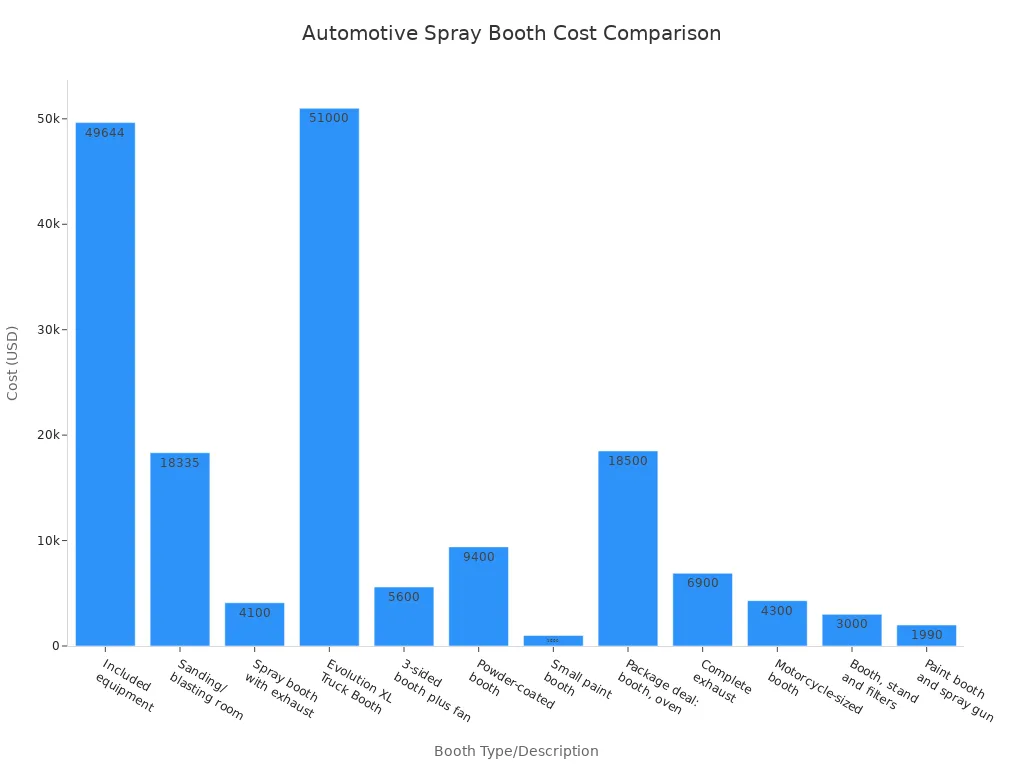
Spray booth prices can be very different. Small booths can cost about $1,000. Big, fancy booths can cost over $50,000. The chart below shows the price range for different booth types:

Bar chart comparing costs of different automotive spray booth types and installations

If you plan for safety, easy cleaning, and good installation, you protect your money and your team.


When picking an automotive spray booth, think about airflow and filtration. Lighting and safety are also important. Make sure the booth fits your shop and cars. Small shops need booths that save space and work well. Big shops do better with strong booths and smart controls. Do not forget to check and change filters often. Good lighting helps you see your work better. Ask experts or suppliers for advice if you are not sure. Shops with better booths finish jobs faster. Their customers are also happier.

Custom Spray Booth or Standard Paint Booth Which Offers Superior Results

If you want the best possible finish and maximum control, a custom spray booth often delivers superior results. You gain the ability to match booth size, airflow, and filtration to your exact project. This means you achieve flawless coatings, efficient drying, and uncompromising safety. Consider the most common factors before you decide:


Factor

Description

Size and Capacity

Handles your largest pieces with ease and precision.

Airflow Design

Maintains a clean environment for consistent finishes.

Filtration Quality

Ensures top air quality while reducing operating costs.

Construction Quality and Durability

Provides long-term reliability for demanding tasks.

Compliance and Safety Features

Meets all safety standards for legal and safe operation.

Specific Production Needs

Adapts to unique processes that standard booths cannot support.

Both custom and standard booths offer unique strengths. Your choice should reflect your finish quality needs, flexibility, and budget.


Key Takeaways

  • Custom spray booths offer tailored features that enhance finish quality and efficiency, allowing for flawless coatings and faster drying times.
  • Safety and compliance are crucial; both booth types must meet industry standards to protect your team and ensure legal operation.
  • Standard paint booths provide cost-effectiveness and ease of use, making them ideal for small businesses or hobbyists with routine projects.
  • Investing in a custom spray booth can lead to long-term savings by reducing rework and improving productivity for specialized tasks.
  • Always assess your project needs and budget to choose the right booth; custom options excel in flexibility, while standard booths are quick to install.


What Are Superior Results


Finish Quality and Efficiency

When you invest in a spray booth, you want results that stand out. Superior results mean you achieve a flawless, even finish every time. You avoid dust, debris, and imperfections that can ruin your hard work. A custom spray booth gives you the power to control airflow, temperature, and humidity. This control leads to faster drying times and consistent paint application. You save time and reduce costly rework. Whether you run an auto body shop or tackle DIY projects, you need a booth that adapts to your needs. For example, a truck spray booth offers the space and airflow needed for large vehicles, while a custom paint booth can be tailored for unique projects or tight spaces.

Tip: Choose a booth with advanced airflow options and high-quality filtration. You will see a dramatic improvement in both finish quality and efficiency.


Safety and Compliance

Safety and compliance are not optional—they are essential. You protect your team, your investment, and your reputation by meeting strict industry standards. Both custom and standard booths must follow regulations that keep your workspace safe and your business legal. The right booth shields you from hazardous fumes, fire risks, and environmental violations.


Here is a quick look at key regulations and standards:

Regulation/Standard

Description

NFPA 33

Ensures safe spray application with flammable materials and proper airflow.

OSHA 29 CFR 1910.107

Focuses on booth construction, ventilation, and safety for flammable materials.

EPA NESHAP

Controls hazardous emissions with effective filtration.

CARB Certification

Regulates VOC emissions for cleaner air.

ISO 9001

Demonstrates commitment to quality management.

IATF 16949

Sets automotive industry compliance standards.

LEED Certification

Promotes energy efficiency and sustainability.

ENERGY STAR

Recognizes energy-efficient equipment.

MIL-SPEC

Meets military coating performance standards.

FAA/EASA Standards

Ensures aerospace coatings meet strict safety criteria.


You also need to look for these features in your spray booth:

  • Noncombustible construction materials
  • Consistent airflow to prevent vapor buildup
  • Explosion-proof electrical equipment
  • Automatic fire suppression systems
  • Easy-to-clean surfaces for overspray control
  • Safe storage for flammable materials
  • Operator training for safe procedures

When you choose a custom spray booth or a truck spray booth that meets these standards, you gain peace of mind and set your business up for long-term success.


Custom Spray Booth Performance


Tailored Features and Airflow Options

When you choose a custom spray booth, you unlock a world of tailored features that directly impact your results. You can select from advanced airflow options like downdraft, semi-downdraft, side downdraft, and crossdraft. Each airflow style shapes how paint particles move, which affects the finish quality and drying speed. Downdraft airflow, for example, pulls air from the ceiling and exhausts it through the floor. This setup removes overspray quickly and keeps contaminants away from your work, giving you a flawless finish every time. You gain precise control over temperature and humidity, which means faster drying and less risk of imperfections. With a custom paint booth, you can match the airflow to your exact project needs, whether you work on cars, trucks, or furniture.

Note: Optimized airflow not only speeds up drying but also reduces overspray, making your workspace cleaner and more efficient.


Custom Paint Booth Sizes and Flexibility

You never have to settle for a one-size-fits-all solution. Custom paint booth sizes range from compact models for small parts to massive booths for trucks or industrial equipment. You can design your custom paint booth to fit your available space, workflow, and production goals. Choose the right dimensions, ventilation options, and door styles to maximize flexibility. This adaptability lets you handle a wide variety of projects, from automotive panels to large furniture pieces. Custom paint booth sizes ensure you always have the right fit for your business.

  • Custom paint booths can be designed for specific operational needs.
  • You can select from a variety of dimensions, ventilation options, and door styles.
  • Both standard and custom sizes are available to meet your finishing requirements.


Advanced Materials and Certifications

A custom spray booth stands out because of its superior construction. You benefit from heavy-duty galvanized steel panels, powder-coated finishes, and high-efficiency air filtration systems. These materials guarantee long-term durability and a safe working environment. Non-sparking fans and advanced filtration keep your workspace safe and clean. You also meet strict industry standards with certifications like OSHA, NFPA, and ETL. This commitment to quality and safety gives you peace of mind and helps you maintain compliance in demanding industries.


Material Type

Purpose

Benefit

Heavy-Duty Galvanized Steel Panels

Provides structural integrity and durability

Ensures long-term reliability in harsh environments

Powder-Coated Steel Finishes

Enhances aesthetics and corrosion resistance

Improves visibility and light distribution

High-Efficiency Air Filtration Systems

Captures overspray and contaminants

Ensures cleaner air and safer operations

Non-Sparking Axial Fans

Ensures safe air movement

Prevents flammable vapor buildup

Certifications

OSHA, NFPA, ETL standards

Ensures compliance with safety regulations

You can trust a custom paint booth to deliver the performance, flexibility, and safety your industry demands. Whether you work in automotive, aerospace, or furniture manufacturing, a custom solution will help you achieve superior results every time.


Standard Paint Booth Benefits


Consistent Results and Reliability

You want every project to look professional. Standard paint booths help you achieve this goal. Their proven designs and reliable systems give you the same high-quality finish, job after job. When you use a well-managed booth, you reduce risks like dust or uneven coatings. This means you get consistent results across all your projects. You can trust the booth to deliver uniform outcomes, whether you paint cars, furniture, or machinery. Standard paint booth sizes also make it easy to match your workspace and production needs.


Cost-Effectiveness and Maintenance

You save money when you choose a standard paint booth. These booths cost less than custom options and require less time to install. You can see the difference in installation times:

Booth Type

Typical Installation Time

Standard Paint Booth

2 to 4 weeks

Custom Paint Booth

Up to 2 to 3 months (including construction)


Standard paint booths are pre-designed, so you avoid long construction periods. You can start painting sooner and keep your business moving. Maintenance is simple because parts are easy to find and replace. You spend less time on repairs and more time on your projects. This makes standard booths a smart choice for small businesses and hobbyists who want great value.

  • Standard booths offer quick setup and lower upfront costs.
  • You can maintain them easily, which keeps your operation running smoothly.


Ease of Use and Installation

You do not need special training to use a standard paint booth. Manufacturers design these booths for easy setup and operation. Portable models let you set up and break down quickly. Lightweight materials and user-friendly features, like pop-up mechanisms, make the process simple. If you are a first-time operator or a hobbyist, you will appreciate how easy it is to get started. Many small business owners and DIY enthusiasts choose standard booths because they fit their needs and skill levels.

Tip: Choose a standard paint booth if you want fast installation, reliable performance, and a user-friendly experience.


Paint Booth Comparison: Custom vs Standard


Quality and Finish

You want your projects to stand out with a flawless finish. A custom spray booth gives you the power to control every detail. You can select advanced airflow styles, precise temperature settings, and specialized filtration. This control leads to a smooth, even coating on every surface. You can achieve professional results on cars, furniture, or industrial parts. If you work with intricate designs, a custom paint booth lets you fine-tune the environment for each job.

Standard paint booths deliver reliable results for most applications. Their proven designs help you avoid common issues like dust or uneven paint. You get consistent quality, especially for routine projects. However, you may not have the same level of control as with a custom spray booth.


Here is a quick comparison of finish quality:

Type of Spray Booth

Quality of Finish Description

Automatic Spray Booths

Offers consistent finishes due to precision application, minimizing variability and ensuring uniformity.

Manual Spray Booths

Allows for a hands-on approach, enabling skilled operators to achieve higher quality finishes for intricate designs.

If you want the highest level of finish, you should consider a custom spray booth or a custom paint booth. You can match the booth to your process and materials for the best results.


Flexibility and Adaptability

You need a paint booth that adapts to your workflow. A custom spray booth gives you unmatched flexibility. You can design the booth to fit your space, your products, and your future growth. You can choose from a range of sizes, door styles, and ventilation options. If you need to paint a truck, a truck spray booth can be built to handle large vehicles with ease.

Standard paint booths offer less flexibility. You get fixed sizes and features. These booths work well for small businesses or hobbyists who want a simple solution. If your needs change, you may need to upgrade or modify your setup.

Tip: If you expect your business to grow or your projects to change, invest in a custom spray booth for long-term adaptability.


Cost and Value

You want to get the most value for your investment. Standard paint booths cost less upfront. You can install them quickly and start working right away. Maintenance is simple, and replacement parts are easy to find. This makes standard booths a smart choice if you have a tight budget or need a fast solution.

A custom spray booth requires a higher initial investment. You pay more for tailored features, advanced materials, and specialized airflow. However, you gain long-term value. You reduce rework, improve finish quality, and boost productivity. If you run a busy shop or handle high-value projects, a custom paint booth pays off over time.

  • Standard paint booths: Lower upfront cost, quick installation, easy maintenance.
  • Custom spray booths: Higher initial cost, greater long-term value, superior performance.


Maintenance and Upkeep

You want your paint booth to run smoothly with minimal downtime. Standard paint booths are easy to maintain. You can find replacement parts quickly. Most repairs are simple, so you spend more time painting and less time fixing equipment.

A custom spray booth may require specialized parts or service. However, you can design the booth for easy access and cleaning. You can choose high-quality materials that resist wear and tear. This means you spend less on repairs in the long run. If you invest in a custom paint booth, you can work with the manufacturer to set up a maintenance plan that fits your needs.


Safety and Compliance

You must protect your team and your business. Both custom and standard paint booths meet basic safety standards. However, a custom spray booth can be tailored to exceed these requirements. You can add advanced fire suppression, enhanced ventilation, and specialized filtration. You can meet strict industry regulations for automotive, aerospace, or industrial painting.


Here is a comparison of safety and compliance features:

Feature

Custom Spray Booths

Standard Paint Booths

Compliance Standards

Tailored to specific industry needs

Meets general industry standards

OSHA Compliance

Often exceeds basic requirements

Meets basic OSHA requirements

NFPA Compliance

May include advanced fire suppression

Standard fire safety measures

  • Custom spray booths may include advanced fire suppression systems tailored to specific risks.
  • Standard paint booths typically have basic fire safety features.
  • Custom booths can be designed with enhanced ventilation systems to meet specific safety regulations.
  • If you need to meet strict compliance standards, a custom spray booth or a truck spray booth gives you peace of mind. You can operate safely and avoid costly fines.

Note: Always check for certifications like ISO9001, CE, and CCS when choosing your paint booth. These marks show a commitment to quality and safety.


Choosing the Right Paint Booth


Project Needs and Scale

You need to match your paint booth to your project’s size and complexity. If you run an automotive repair shop, consider what you paint most often and how much space you have. Large-scale industrial projects often require a custom spray booth to handle unique processes and boost efficiency. Smaller jobs or DIY projects may fit perfectly in a standard booth, which offers quick setup and reliable performance.

  • Assess what you plan to paint and the size of your workspace.
  • Check regulatory and safety requirements for your industry.
  • Evaluate your available space and how the booth will fit into your workflow.
  • Analyze how booth size affects your operating costs.
  • For specialized needs, talk with manufacturers about a custom paint booth or truck spray booth.

The scale of your project can determine if you need a custom solution or if a standard booth will meet your needs. Large operations benefit from custom booths, while smaller projects often find standard booths more practical.


Budget and Long-Term Goals

Your budget shapes your options, but you should also think about long-term value. Standard booths cost less upfront and install quickly. Custom spray booths require a higher investment, but they deliver efficiency and tailored features that pay off over time.


If you plan to grow your automotive business or take on larger projects, investing in a custom paint booth can save money in the long run by reducing rework and boosting productivity.


When to Choose Custom or Standard

You should choose a custom spray booth when standard sizes do not fit your needs, or when you want to ensure optimal performance and compliance. Custom booths adapt to your exact specifications and help you meet strict regulations.

  • Custom booths are ideal for unique projects, large vehicles, or when you need advanced features.
  • Standard booths work best for routine jobs, smaller spaces, or when you want fast installation.

When selecting a booth, prioritize airflow efficiency, compliance with local ventilation rules, and curing technology—especially for sensitive finishes.

Consideration

Details

Customization

Custom booths match your operational needs and compliance standards.

Compliance

Advanced filtration and exhaust systems keep you safe and legal.

Long-term Cost Efficiency

Higher initial costs can lead to savings through efficiency.

Specific Requirements

Know your production volume and quality standards.

Budget Considerations

Balance customization with cost for the best return.

Space Configuration

Choose the right booth style for your available space.

If you want flexibility, growth potential, and the best finish for your automotive projects, a custom spray booth or truck spray booth is the smart choice.


You gain superior results with a custom spray booth when your projects demand advanced features, flexibility, and strict compliance. Standard paint booths work best for routine jobs and smaller budgets. Always match your booth to your needs, budget, and long-term goals. Consider these key points:

  • Boost productivity and consistency with automation.
  • Improve safety and environmental compliance with advanced filtration.
  • Save costs by optimizing paint usage.

Consult with industry experts or manufacturers before you decide. Their guidance ensures your custom paint booth or truck spray booth fits your business perfectly.


FAQ


What makes a custom spray booth superior for specialized projects?

You get unmatched control with a custom spray booth. You choose booth size, airflow, and filtration. This flexibility lets you handle unique items, from cars to furniture. Spray booth manufacturers design each booth for your specific needs, ensuring flawless finishes and efficient drying.


How do I choose between a standard booth and a custom paint booth?

You should consider your project size, finish quality, and future growth. Standard booths work well for routine jobs. If you want advanced features or need to paint trucks, a custom paint booth or truck spray booth gives you better results. Consult spray booth manufacturers for expert advice.


Are custom booths more expensive than standard booths?

Custom booths cost more upfront. You pay for tailored features and advanced materials. Over time, you save money by reducing rework and boosting productivity. Spray booth manufacturers can help you find the right balance between cost and value for your business.


What certifications should my booth have for safety and compliance?

You need booths with ISO9001, CE, and CCS certifications. These marks show commitment to safety and quality. Spray booth manufacturers offer booths that meet strict industry standards. Always check for compliance before you buy a booth.


Can I upgrade my booth as my business grows?

You can upgrade your booth or add features as your needs change. Custom spray booth options let you expand or modify airflow, filtration, and size. Spray booth manufacturers work with you to ensure your booth supports future growth and new projects.

Custom Truck Spray Booths or Off-the-Shelf Which Works Best

Are you considering an upgrade or expansion for your paint facility? Choosing the right truck spray booth shapes your paint quality, safety, and future growth. Most businesses find that off-the-shelf solutions deliver excellent results for typical needs. Industry data shows that features like airflow control directly affect finish quality and business potential. For example, full downdraft booths offer the best airflow and highest quality finishes, while semi-downdraft types provide consistent results across many applications.

Spray Booth Type

Airflow Control

Impact on Paint Quality

Business Growth Potential

Full Downdraft

Best

Highest quality finishes

Ideal for high-end refinishing

Semi-Downdraft

Consistent

Cleaner environment

Versatile for various applications

Side-Downdraft

Moderate

Adequate finishes

Suitable for general use


Key Takeaways

  • Choose off-the-shelf spray booths for quick installation and lower costs. They suit standard truck sizes and provide reliable performance.
  • Opt for custom spray booths when you face unique challenges. They allow tailored airflow and filtration, boosting productivity and paint quality.
  • Evaluate your business size and production volume. Match booth dimensions and features to your specific needs for optimal results.
  • Consider long-term savings. Custom booths may have higher upfront costs but offer lower operational expenses and better ROI over time.
  • Prioritize safety and compliance. Ensure your booth meets regulatory standards to protect workers and avoid costly penalties.


Quick Answer: Which Truck Spray Booth Wins

Best Choice for Most Businesses

You want a spray booth that delivers consistent results, keeps your team safe, and supports your business growth. Most companies find that off-the-shelf truck spray booths meet these needs. Manufacturers design these booths for reliability and efficiency. You benefit from proven airflow systems, standardized safety features, and straightforward installation.

Tip: If you operate a medium-sized shop or manage a fleet, you likely gain the most value from an off-the-shelf booth. These models handle a wide range of truck sizes and paint jobs without requiring major adjustments.

Consider these advantages:

  • Faster installation: You get up and running quickly.
  • Lower upfront investment: You avoid custom engineering costs.
  • Regulatory compliance: You receive documentation and certifications from the manufacturer.
  • Scalable options: You can add more booths as your business grows.

Feature

Off-the-Shelf Booths

Custom Booths

Installation Speed

Fast

Slow

Cost

Lower

Higher

Compliance

Standardized

Requires review

Flexibility

Moderate

High

Truck Paint Booths

When to Go Custom or Off-the-Shelf

You should choose a custom booth when your operation faces unique challenges. For example, you may need to paint oversized trucks, handle specialty coatings, or fit a booth into a non-standard space. Custom booths allow you to tailor airflow, filtration, and layout to your exact workflow. You gain control over every detail, which can boost productivity and paint quality.

Note: Custom booths require careful planning. You must work with engineers and vendors to design, build, and install the booth. This process takes time and increases costs, but you achieve a solution that fits your business perfectly.

You should select an off-the-shelf booth if:

  • You paint standard truck sizes.
  • You want a quick installation.
  • You need predictable costs.
  • You value proven performance.

You should select a custom booth if:

  • You handle unique truck shapes or sizes.
  • You require advanced airflow or filtration.
  • You need to fit the booth into a challenging space.
  • You plan for future expansion with modular designs.

You make the best choice by matching your booth to your business needs. Evaluate your workflow, budget, and growth plans. You ensure quality and efficiency when you select the right spray booth for your operation.


Truck Spray Booth Types Compared

What Is a Custom Truck Spray Booth

A custom truck spray booth gives you a tailored solution for your commercial vehicle painting needs. Manufacturers design these booths to create a controlled environment that boosts safety and efficiency. You benefit from specialized airflow systems that optimize paint application and reduce overspray. Environmental controls maintain ideal conditions for curing, which directly impacts the final quality of your work. Safety features, such as advanced exhaust and filtration systems, help you meet strict regulations and protect your team.

Feature

Description

Specialized Airflow Systems

Optimize paint application and reduce overspray for better quality.

Environmental Controls

Maintain ideal curing conditions for consistent results.

Safety Features

Include exhaust and filtration for compliance and operator safety.

Customization Options

Adapt to your unique workflow and space requirements.

You also get heavy-duty construction, high-performance lighting, and efficient airflow management. These features ensure even paint distribution and help you achieve the highest quality finishes, even when working with a crossdraft paint booth setup.


What Is an Off-the-Shelf Spray Booth

An off-the-shelf spray booth offers you a ready-made solution for most standard truck painting jobs. These booths come in a range of sizes, from compact models to large commercial units. You will find multi-stage filtration systems that meet HEPA standards, supporting both water-based and solvent-based paints. Integrated heating and cooling systems keep the temperature between 68°F and 86°F, which helps maintain paint quality.

Specification/Limitations

Details

Size and Dimensions

3m x 8m (compact) to 6m x 15m (large commercial).

Filtering System

Multi-stage: particulate, carbon, water wash, HEPA recommended.

Paint System Compatibility

Water-based, solvent-based, powder coating.

Temperature Control

68°F to 86°F with integrated systems.

Limitations

Less durable, limited climate control, not for high-volume use.

Best Applications

Mobile painters, on-site restoration, small workshops.

You may notice that a crossdraft paint booth in this category provides reliable results for general applications. However, it may not deliver the same level of quality as a custom solution, especially for high-volume or specialty work.


Key Differences

When you compare custom and off-the-shelf booths, you see clear differences in flexibility, durability, and quality. Custom booths let you adapt every detail, from airflow to lighting, which helps you achieve superior quality and handle unique projects. Off-the-shelf booths focus on convenience and speed, making them ideal for standard jobs and smaller operations.

  • Custom booths: Maximum flexibility, higher quality, tailored for unique needs, suitable for any crossdraft paint booth configuration.
  • Off-the-shelf booths: Faster setup, lower cost, best for typical crossdraft paint booth uses, but may limit your ability to scale or handle specialty work.

Tip: If you want the best possible quality and need to accommodate unusual truck sizes or workflows, a custom booth gives you the edge. For routine jobs, an off-the-shelf crossdraft paint booth often meets your needs efficiently.


Finish Quality & Overspray Control

Truck Spray Paint Booth

Custom Booth Performance

You achieve the highest finish quality when you use a custom truck spray booth. Custom booths let you regulate temperature, humidity, and airflow with precision. This level of control ensures that every layer of paint cures under optimal conditions. You avoid common defects like runs, sags, or uneven gloss. Custom booths also feature advanced ventilation systems. These systems keep the air clean and remove contaminants before they reach the painted surface. You benefit from high-efficiency filtration, which captures dust and particles. This attention to detail supports a flawless finish quality on every job. You also improve worker safety by reducing exposure to harmful fumes and particles.

  • Custom booths maintain stable environmental conditions for any coating type.
  • You reduce the risk of overspray landing on freshly painted surfaces.
  • Filtration systems help you meet strict regulatory standards.


Off-the-Shelf Booth Performance

Off-the-shelf spray booths deliver reliable finish quality for standard truck painting tasks. Manufacturers design these booths with proven airflow patterns and basic filtration. You get consistent results on most jobs, especially when painting standard truck sizes. However, you may notice some limitations. Off-the-shelf booths do not always allow you to fine-tune temperature or humidity. This can affect finish quality, especially with specialty coatings or in challenging climates. Overspray can become a bigger issue if the booth lacks advanced overspray control features. You may see more touch-ups or rework when painting complex surfaces.

Note: Off-the-shelf booths work best for routine projects where finish quality requirements are moderate and environmental conditions remain stable.


Impact on Paint Results

Your choice of spray booth directly impacts finish quality. Custom booths give you the tools to achieve showroom-level results. You control every variable, so you minimize overspray and maximize paint adhesion. Off-the-shelf booths provide good finish quality for most applications, but you may sacrifice some consistency and control. If your business depends on flawless finishes or you handle specialty coatings, a custom booth gives you a clear advantage. For general fleet work, an off-the-shelf booth often meets your finish quality needs at a lower cost.

  • Custom booths: Superior finish quality, fewer defects, better overspray control.
  • Off-the-shelf booths: Good finish quality, but less flexibility for unique jobs.


Safety & Compliance in Spray Booths

Meeting Regulations

You must prioritize safety and compliance when selecting a truck spray booth. Regulatory bodies in the United States and Europe set strict health and safety regulations for paint operations. These rules protect workers and the environment. You need to follow emission standards, install proper filtration systems, and meet exhaust stack regulations. Permitting requirements include air quality permits, fire safety approvals, and occupational health clearances. Regular compliance checks ensure ongoing adherence to health and safety regulations.

Compliance Requirement

Description

Emission Standards

Governed by EPA and EU VOC directives, dictating allowable VOC levels.

Filtration Systems

Multi-stage filters including pre-filters and activated charcoal filters for solvent capture.

Exhaust Stack Regulations

Height and placement regulations to ensure proper dispersion of emissions.

Permitting Requirements

Air quality permits, fire safety approvals, and occupational health clearances are often needed.

Regular Compliance Checks

Ongoing requirements for filter replacement logs and emission testing.

Tip: You should keep detailed records of filter changes and emission tests. This practice helps you pass inspections and maintain compliance.


Airflow, Filtration, and Worker Safety

Airflow and filtration systems play a critical role in safety and compliance. You rely on intake filters to clean incoming air and prevent contamination. Fiberglass filters handle large particles, while pleated filters offer higher efficiency and longer life. Exhaust filters capture overspray and contaminants before air leaves the booth. Carbon filters remove VOCs and odors, supporting health and safety regulations. HEPA filters trap 99.97% of particles, making them essential for high-precision work.

  • Air filtration systems maintain paint quality and protect workers.
  • Intake filters prevent contamination from outside air.
  • Exhaust filters capture overspray and harmful substances.
  • Carbon filters reduce VOCs and odors.
  • HEPA filters ensure maximum particle removal.

You create a safer work environment by investing in advanced filtration and proper airflow. These features help you meet safety and compliance standards and support long-term business success.


Flexibility & Modular Paint Booths

Flexibility & Modular Paint Booths
Image Source: unsplash

Adapting to Unique Workflows

You face changing demands in truck painting operations. Modular paint booths give you the flexibility to adapt quickly. You can customize the size, shape, and layout to match your workflow. This approach lets you integrate modular paint booths into your facility, even if you have limited space. You avoid the need for major renovations. You gain the ability to expand or reconfigure your booth as your business grows. Modular paint booths support seamless transitions between different projects. You can relocate or adjust the booth with minimal downtime. You maintain high productivity and keep your team focused on quality.

Modular paint booths help you respond to new challenges. You can add sections, change airflow patterns, or upgrade lighting without disrupting your operations. You achieve better environmental control, which improves paint quality and worker safety.

  • Modular paint booths offer:
  • Customization for unique workflows
  • Quick installation and operational readiness
  • Integration with existing systems
  • Minimal disruption during upgrades or moves
  • Enhanced environmental control for consistent results

Upgrades and Future Expansion

You plan for growth and innovation in your business. Modular paint booths make upgrades and expansion simple. You add new modules or features as your needs change. You avoid costly system overhauls. You maintain environmental control by expanding filtration or ventilation systems. Modular paint booths let you scale your operations without sacrificing quality. You can upgrade heating, cooling, or lighting as technology advances. You keep your facility up to date and competitive.

You invest in modular paint booths to future-proof your business. You gain flexibility, scalability, and reliable environmental control. You support ongoing success and meet evolving industry standards.

You choose modular paint booths when you value customization, adaptability, and long-term growth. You create a workspace that evolves with your business and delivers consistent results.


Cost-Efficiency & Value

Upfront Costs

You face a critical decision when evaluating the initial cost of truck paint booths. Off-the-shelf models require a lower upfront investment. Manufacturers design these booths for standard applications, so you avoid custom engineering fees. You can quickly budget for installation and start operations without delay. Custom booths demand a higher initial cost. You pay for tailored design, specialized components, and expert installation. This investment suits businesses with unique requirements or high-volume operations.

Tip: If you want to minimize upfront cost and launch your paint facility fast, an off-the-shelf booth offers a practical solution.


Long-Term Savings

You must consider long-term cost-efficiency when choosing a spray booth. Custom booths deliver lower operational costs over time. You benefit from optimized airflow, advanced filtration, and energy-efficient systems. These features reduce waste and improve productivity. Off-the-shelf booths may incur higher operational costs due to less efficient systems and limited adaptability. You spend more on energy, filter replacements, and maintenance.

Type of Booth

Initial Investment

Long-term Operational Costs

Efficiency and Adaptability

Custom Paint Booths

Higher

Lower due to efficiency

High, customizable

Off-the-shelf Booths

Lower

Higher due to inefficiencies

Limited

You achieve greater cost-efficiency with a custom booth if you plan for growth and prioritize operational savings.


Maintenance and Operation

You must manage ongoing maintenance to protect your investment. Custom booths often feature durable materials and modular components. You replace filters and parts less frequently, which lowers maintenance cost. Off-the-shelf booths require more frequent upkeep. You may need to address wear and tear sooner, especially in high-volume environments. Routine maintenance ensures consistent performance and compliance with safety standards.

  • Custom booths: Lower maintenance cost, longer lifespan, easier upgrades.
  • Off-the-shelf booths: Higher maintenance cost, shorter lifespan, limited upgrade options.

You maximize cost-efficiency and productivity by selecting a booth that aligns with your operational needs and maintenance capabilities.


Installation & Lead Time

Custom Booth Setup

You need careful planning and expert guidance when you install a custom truck spray booth. The process starts with a detailed site assessment. You work with engineers to design a booth that fits your space and workflow. Custom booths often require special foundations, electrical work, and integration with existing systems. You must coordinate with local authorities to secure permits and schedule inspections. The installation team will assemble the structure, install ventilation systems, and test all safety features. This process can take several weeks or even months, depending on the complexity of your requirements.

Tip: Plan for extra time if your facility needs structural changes or if you operate in a region with strict building codes.


Off-the-Shelf Installation

You benefit from a much faster installation when you choose an off-the-shelf spray booth. Manufacturers deliver these booths in pre-engineered modules. Your team can assemble the booth quickly, often within a few days. Most off-the-shelf models come with clear instructions and standardized parts. You connect the booth to your existing utilities and start operations soon after delivery. This approach reduces the need for specialized labor and minimizes the risk of unexpected delays.

  • Off-the-shelf booths offer:
  • Shorter lead times
  • Simple assembly
  • Fewer permitting challenges


Downtime Impact

You must consider how installation affects your business operations. Custom booth setups can lead to extended downtime. You may need to pause production while crews complete construction and testing. This downtime can impact your revenue and disrupt your workflow. Off-the-shelf booths help you avoid long interruptions. You return to full productivity quickly, which supports your bottom line. Always schedule installations during slow periods to reduce the impact on your business.


Choosing the Right Spray Booth

Business Size & Volume

You must evaluate your business size and production volume before selecting a paint booth. Small shops often require compact booths with basic airflow and filtration. Medium-sized operations benefit from larger booths that balance part dimensions and operator access. Large facilities need high-capacity paint booth systems to avoid bottlenecks and waste. Consider the following factors:

Factor

Description

Size and Capacity

Match booth dimensions to project sizes and workflow.

Airflow and Filtration

Maintain air quality and prevent contamination.

Lighting and Visibility

Ensure accurate color matching and safe working conditions.

A paint booth that fits your operation supports productivity and delivers consistent results.


Budget & ROI

You must weigh initial investment against long-term value. Custom paint booth designs offer energy efficiency and durability, which reduce operational costs. Off-the-shelf booths require lower upfront spending but may lead to higher maintenance expenses. Custom booths minimize contamination and ensure compliance, reducing the risk of fines. High-quality finishes enhance your brand reputation and customer trust. Future upgrades keep your paint booth relevant as technology evolves.

  • Custom booths: Lower maintenance, longer service life, better ROI.
  • Off-the-shelf booths: Faster setup, predictable costs, suitable for standard needs.


Regulatory Needs

Regulatory compliance is critical when choosing a paint booth. OSHA mandates non-combustible materials and proper ventilation to prevent fire hazards. You must install explosion-proof equipment and automatic sprinkler systems. Filters and fans require regular maintenance to avoid contamination and ensure efficient operation. EPA regulations demand filter systems with at least 98% capture efficiency. You must enclose and ventilate the spray area, operate at negative pressure, and use reduced air emission spray guns. Facilities must maintain records and report emissions.

Tip: Always check local regulations before purchasing a paint booth to avoid costly upgrades or penalties.


Future Growth

You should plan for future expansion when selecting a paint booth. Advanced filtration systems support eco-compliance and VOC capture. Efficient curing systems reduce downtime. Customizable booth designs adapt to operational needs and large-scale repainting. Climate-controlled environments ensure precise color matching. Stable temperature and humidity support high-quality finishes. Integrated bake cycles enable fast turnaround. Explosion-proof lighting meets safety standards. Automated spray systems deliver consistent coverage. Quick-dry systems allow rapid redeployment of emergency vehicles.

Feature

Benefit

Customizable designs

Adapt to changing workflows and business growth

Efficient curing systems

Reduce downtime and improve productivity

Advanced filtration

Prevent contamination and support regulatory compliance

A paint booth that supports future growth protects your investment and keeps your business competitive.


You gain a controlled environment with a truck spray booth, which ensures a high-quality paint job and a top-quality final product. Custom booths offer scalable solutions, maintain air quality, and support compliance and quality control. Off-the-shelf booths provide easy installation and cost savings. Review the table below to compare options:

Aspect

Custom Booths

Off-the-Shelf Booths

Finish Quality

Superior

Consistent

Overspray Control

Efficient

Reliable

Installation

Complex

Easy installation

Flexibility

Scalable

Standard

Assess your needs for a spray booth by considering size, ventilation, lighting, durability, and regulations. Avoid common mistakes like neglecting filter maintenance or improper airflow. Consult vendors for expert advice and improved outcomes.

How Commercial Vehicle Spray Booths Enhance Painting Results for Trucks and Buses

A commercial vehicle spray booth tackles common paint problems for trucks and buses by creating a controlled environment that ensures a higher quality output. You benefit from advanced features like downdraft airflow and robust filtration, which work together to prevent issues such as uneven finish or contamination. Modern systems support an efficient painting process, reduce curing time, and help you achieve a professional-grade finish. Many spray booths now address environmental problems by capturing VOCs and using energy-efficient technology. These advances deliver superior paint finish quality, aligning with stricter regulations and your need for quality, safety, and sustainability.


Key Takeaways

  • Commercial vehicle spray booths create a controlled environment that enhances paint quality by managing temperature and humidity.
  • Advanced filtration systems in spray booths capture dust and VOCs, ensuring a clean workspace and protecting both health and the environment.
  • Downdraft airflow systems reduce overspray and improve paint transfer efficiency, leading to a flawless finish on large vehicles.
  • Consistent coating thickness and improved lighting in spray booths help detect defects early, resulting in fewer reworks and better overall performance.
  • Choosing the right spray booth with advanced features boosts efficiency, safety, and the quality of paint jobs for trucks and buses.


Controlled Environment in Commercial Vehicle Spray Booths

A controlled environment forms the backbone of high-quality paint spray booths for trucks and buses. You need precise management of temperature and humidity to achieve the best paint finish quality. Advanced paint spray booths, such as those from GZ GUANGLI EFE CO.,LTD., offer spacious interiors and comply with international standards. These features help you maintain consistent results and reduce costly rework.


Temperature and Humidity Control

You control temperature and humidity in modern paint spray booths to create the ideal setting for paint application. This control leads to better paint adhesion and a flawless finish. When you keep the environment stable, you avoid common problems like uneven drying or surface defects. The table below shows how temperature and humidity control benefits your painting process:

Key Benefits of Temperature and Humidity Control

Description

Consistent Finishes

Maintaining a stable environment ensures even paint application and reduces the risk of defects like runs or bubbles.

Faster Drying Times

With proper control, paint dries more quickly and consistently, which can increase your shop’s throughput.

Improved Paint Quality

Certain paints, especially automotive and industrial coatings, require specific temperatures and humidity levels for optimal results.

You see these advantages in commercial spray booth and industrial spray booth setups for vehicles. While a furniture spray booth also manages climate, the scale and airflow requirements differ greatly for trucks and buses.


Consistent Curing and Drying

You rely on consistent curing and drying to achieve a durable finish. Paint spray booths use advanced airflow systems to keep air moving evenly around the vehicle. This airflow prevents hot spots and cold zones, which can cause uneven drying. You get a uniform paint finish quality every time.

Paint spray booths with mobile operation control systems can reduce energy usage by up to 40% compared to standard models. These systems adjust fan and motor speeds based on real-time demand. You save energy and maintain the right conditions for curing and drying.


Preventing Bubbling and Cracking

You want to avoid bubbling and cracking in your paint finish. Paint spray booths help you do this by keeping the environment stable and clean. Here are some common causes of bubbling and cracking, and how you can address them:

  • Solvent popping happens when trapped solvent expands and breaks through the paint film.
  • Incorrect spraying viscosity and inadequate drying times lead to surface defects.
  • Temperature fluctuations cause paint to dry unevenly, resulting in cracks and bubbles.

Cause

Description

Solution

Temperature Fluctuations

Can cause paint to dry unevenly, leading to defects like cracking and bubbling.

Regular inspection and maintenance of the booth’s climate control system to maintain stability.

You can prevent these issues by starting with a clean surface, using recommended thinners, and applying thin, even coats. Regular maintenance of your paint spray booths, including filter changes and inspections, ensures you keep the environment optimal for every job.

Tip: Following international standards like NFPA 33, OSHA, IFC, and EPA helps you maintain safety, environmental responsibility, and consistent paint finish quality in your spray booths.

Paint spray booths designed for commercial vehicles offer the space, airflow, and control you need for top-quality results. You see the difference in the finish, durability, and overall appearance of your trucks and buses.


Overspray Control and Airflow Management


Downdraft Airflow for Overspray Reduction

You want a flawless finish when painting trucks and buses. Downdraft airflow systems in spray booths help you achieve this by directing air from the ceiling straight down to the floor. This design pulls overspray away from the vehicle surface, so paint particles settle evenly and do not linger in the air. You get better paint transfer efficiency and fewer defects. The table below compares the effectiveness of different airflow systems for reducing overspray:

Airflow System Type

Effectiveness in Reducing Overspray

Downdraft

Ensures even paint mist settlement, improving paint transfer efficiency and reducing overspray and defects.

Side-draft

Also effective, but less preferred compared to downdraft for this specific application.

A commercial spray booth with downdraft airflow gives you the best results for large vehicles. You see a clear difference in finish quality compared to other systems. Industrial spray booth designs often use downdraft airflow for this reason. In contrast, a furniture spray booth may use different airflow patterns because the objects are smaller and require less intense overspray control.


Uniform Coating Application

You need even paint application for a professional look and long-lasting protection. Advanced airflow management plays a key role in this process. Downdraft airflow uses gravity to remove overspray and contaminants from the painted surface. This method stands out as the most effective for achieving high-quality finishes on large vehicles. Other airflow types, such as cross-draft and side-draft, offer benefits in certain situations. Cross-draft moves air horizontally, which can leave more overspray particles near the vehicle. Side-draft works well in narrow spaces and balances performance with space efficiency.

  • Downdraft airflow ensures uniform airflow across the entire vehicle, so every part receives the same amount of paint.
  • You avoid streaks, blotches, or thin spots, which can affect the finish and durability.
  • Uniform airflow also helps you achieve consistent color and gloss, which is important for fleet branding and customer satisfaction.

You get the most reliable results when you use a spray booth designed for trucks and buses. These booths provide the space and airflow needed for even coverage, unlike a furniture spray booth, which is built for smaller items.


Air Quality and Operator Safety

Overspray control is not just about finish quality. You also protect your health and the environment. Spray booths with advanced air quality controls remove hazardous fumes, overspray, and airborne contaminants. This protection reduces fire hazards and shields you from toxic exposure. You work in a safer environment and meet strict safety standards.

  • Spray booths create a controlled environment that minimizes health and environmental hazards by managing overspray and emissions.
  • Advanced filtration systems, including pre-filters, primary filters, and exhaust filters, capture harmful particles and VOCs. Cleaner air leaves the booth, which helps protect the environment.
  • You comply with EPA and OSHA regulations, which require you to control VOC emissions and manage hazardous waste.
  • You also improve efficiency and productivity. A clean booth means less time spent on rework and more time producing high-quality finishes.

Tip: Always check that your spray booth meets international safety and environmental standards. This step ensures you protect both your team and the planet.

Overspray control in commercial spray booths and industrial spray booths makes a big difference in your daily operations. You achieve a better finish, maintain high quality, and create a safer workplace. These benefits set you apart in the competitive world of truck and bus painting.


Contamination Prevention and Filtration


Advanced Filtration Systems

You need to keep dust and contamination away from your paint jobs. Advanced filtration systems in a commercial spray booth or industrial spray booth help you achieve this goal. These systems remove dust before it can settle on the surface of trucks and buses. You get a dust-free working environment, which is essential for a flawless finish. The table below compares two common filtration systems and their best uses:

Filtration System

Advantages

Best Applications

Water Wash

Superior overspray capture efficiency

Aerospace, Automotive, Heavy Equipment


Continuous operation capability

High-Production Metal Fabrication


Enhanced fire safety


Dry Filter

Lower initial investment

Custom Job Shops, Powder Coating


Simplified installation

Wood Finishing, Low-Medium Volume


No water treatment required


You see that water wash systems work best for high-volume operations, while dry filters suit smaller or custom jobs. Both types help you control dust and maintain consistent booth conditions.


VOC and Particle Capture

You must also manage harmful particles and volatile organic compounds (VOCs) during painting. Filtration systems in a commercial spray booth use multi-stage filters to trap dust, paint overspray, and VOCs. This process protects both you and the environment. Intake and exhaust filters remove dust from the air before it reaches the painting area. Efficient overspray capture allows the coating to level and cure evenly, which improves the final result.

Note: Proper filtration not only keeps your workspace clean but also helps you meet EPA regulations for VOC emission control and hazardous waste management.


Clean Painting Environment

You want every paint job to look professional and last longer. A clean painting environment starts with effective filtration. Spray booths create a controlled space that isolates the painting process from dust and airborne particles. This control ensures even paint application and prevents defects like rough texture or uneven thickness. You can spot and correct surface issues quickly with proper lighting and a dust-free environment.

Compliance with international standards matters. The table below shows how filtration systems help you meet safety and sustainability goals:

Compliance Benefit

Description

VOC Emission Control

High-efficiency filtration meets EPA regulations.

Hazardous Waste Management

Prevents chemical spills and ensures proper disposal.

Air Quality Protection

Multi-stage filters capture toxins and pollutants.

You see the difference between a commercial spray booth or industrial spray booth and a furniture spray booth. Vehicle booths require more advanced filtration to handle the larger amount of dust and contamination. This focus on air quality and safety sets vehicle spray booths apart and ensures you deliver top-quality results every time.


Consistent Finishes and Enhanced Lighting

You want every truck or bus to leave your facility with a flawless, durable finish. Consistent coating thickness and improved lighting play a major role in achieving this goal. A commercial spray booth or industrial spray booth uses advanced lighting systems and thoughtful booth design to help you spot defects before they become costly problems. You can see imperfections like runs, sags, or thin spots early, which means you can correct them right away. This attention to detail leads to fewer coating problems and better overall performance.


Uniform Coating Thickness

You need consistent coating thickness to prevent defects and ensure long-term durability. In a commercial spray booth, you control airflow and lighting to achieve even coverage on every surface. Industrial spray booths for vehicles use high-output, shadow-free lighting that lets you see every inch of the vehicle. You can compare this to a furniture spray booth, which may not require the same level of lighting or airflow control due to smaller workpieces. Uniform thickness reduces the risk of poor paint adhesion and helps you avoid coating problems that can lead to early wear or corrosion.


Improved Paint Adhesion

You improve paint adhesion by maintaining a clean, well-lit environment. Enhanced lighting allows you to detect surface defects and address them before applying the next coat. This process leads to better finish consistency, fewer touch-ups, and improved energy efficiency. The table below highlights measurable benefits you gain from improved paint adhesion in a well-designed booth:

Benefit

Description

Improved Finish Consistency

Ensures a uniform appearance across painted surfaces.

Reduced Rework

Minimizes the need for touch-ups and corrections.

Better Energy Efficiency

Lowers operational costs through optimized energy use.

You see that proper adhesion not only boosts performance but also saves time and resources.


Accurate Color Matching

You rely on accurate color matching to meet customer expectations and maintain brand consistency. Modern commercial spray booths use intelligent controls and digitized communication systems to enhance efficiency and flexibility. You benefit from color-management systems that allow quick color changes and reduce solvent use, making your process more eco-friendly. Modular booth designs let you upgrade as new technologies become available. These features help you avoid defects and coating problems while delivering a consistent, high-quality finish every time.

Tip: Customization and versatility in booth design let you adapt to different vehicle sizes and painting requirements, giving you a competitive edge in the market.


You solve many painting challenges for trucks and buses by using a commercial spray booth or industrial spray booth. Advanced features boost your results and make your work safer and more efficient.

  • Spacious design lets you move easily and cover large vehicles.
  • Advanced ventilation removes dust and VOCs, keeping your finish clean.
  • Infrared heating speeds up drying.
  • LED lighting helps you spot flaws right away.

Feature

Benefit

Downdraft Booths

Cleaner, high-quality finish with less overspray.

Hybrid Designs

Precision for custom finishes.

Advanced Filtration

Clean air and fewer imperfections.

Smart Automation

Consistent color and application.

A furniture spray booth works for smaller items, but you need these advanced features for trucks and buses. Choose the right spray booth to achieve top-quality, environmentally responsible results.


FAQ

What makes a commercial spray booth different from a furniture spray booth?

A commercial spray booth handles large vehicles like trucks and buses. You get more space, stronger airflow, and advanced filtration. A furniture spray booth works for smaller items and does not need the same airflow or size.


Why should you choose an industrial spray booth for vehicle painting?

You need an industrial spray booth for trucks and buses because it provides even airflow, strong filtration, and enough room for large vehicles. This setup helps you achieve a flawless finish and meet safety standards.


How does a spray booth improve paint quality?

A spray booth gives you a controlled environment. You avoid dust, control temperature, and manage humidity. These features help you get smooth, even paint on every vehicle.


Is a commercial spray booth environmentally friendly?

Yes. You use advanced filtration in a commercial spray booth to capture VOCs and harmful particles. This system protects both you and the environment.


Can you use a furniture spray booth for trucks or buses?

No. A furniture spray booth is too small and lacks the airflow needed for large vehicles. You should use a commercial or industrial spray booth for trucks and buses.


How Much Does a Paint Booth Cost

If you want to know how much a paint booth costs, prices can range widely based on type and size. For example, a portable paint booth (10x10) often costs about $4,495. Custom paint booths can vary depending on your needs.

Type of Paint Booth Price Range
Portable (10x10) $4,495.00
Custom Varies

The cost changes based on booth size, ventilation, materials, and extra features. You should look at every cost factor before you decide to buy.


Key Takeaways

  • Paint booth prices change a lot depending on size, type, and features. Portable booths cost about $2,000. Big custom booths can cost more than $40,000.
  • Think about the booth size before buying. Bigger booths have better airflow and work faster. But bigger booths also cost more money.
  • Some booths have special features like good filters, heating, and safety gear. These features can make the booth cost more. Pick features that help keep you safe and work better. Try not to spend too much.
  • It costs money to install and take care of the booth. Make sure you plan for these costs. This helps you avoid problems and keeps your booth working well.
  • Always check your local rules for permits before you set up the booth. Following the rules helps you avoid fines. It also keeps your work area safe.


auto spray paint booth


Paint Booth Price Overview


When you look for a paint booth, you will see prices are very different. The price changes because of the size, type, and features you want. Here is a simple list of the most common paint booths and what you might pay.


Portable Paint Booths

Portable paint booths are easy to move and set up. You can put them where you need them. Most portable booths have inflatable walls or light frames. They usually cost between $2,000 and $12,000. The price depends on the size and features.

Tip: Portable booths often have EPA-compliant ventilation, exhaust filters, and air movers. These things help keep your work area safe and clean.

Size/Type Price Range Key Features
Small (10x10) $2,000 - $5,000 Cheap, easy to set up, good for hobbies
Medium (12x12x9) $5,000 - $7,000 Small, good for little jobs
Large (18x15x10 or 24x15x10) $9,000 - $12,000 Big, for pros, better air flow

You can also buy simple tent-style booths for less than $100. These do not have air filters and may not be safe.


Small Paint Booths

Small paint booths are good for small spaces or little projects. You might use one to paint car parts or small tools. Prices start at about $3,000 and go up to $8,000. The price depends on how big the booth is, what it is made of, and the airflow system.

  • Bigger booths cost more money.
  • The way the booth moves air, like downdraft or crossdraft, changes the price.
  • Better filters or safety features make the booth cost more.
Factor Impact on Price
Size Bigger booths cost more
Configuration Downdraft costs more than crossdraft
Materials Stainless steel costs more than regular steel
Filtration Multi-stage HEPA systems make the price go up
Compliance Meeting safety rules adds to the price


Medium Paint Booths

Medium paint booths are used in most auto shops and small businesses. You will pay between $8,000 and $15,000 for a medium booth. These booths have more space and better air flow than small booths.

  • Medium booths often have better air and lights.
  • Some have heaters to dry paint faster.
  • Following environmental rules can make the price higher.

Pick a medium booth if you need to paint whole cars or big parts often.


Large Paint Booths

Large paint booths are for big jobs, like trucks, trailers, or big machines. Prices are usually between $19,000 and $40,000. These booths are used in places like airplane factories, heavy equipment shops, and RV makers.

  • Bigger booths need more materials and cost more to install.
  • Fancy air systems, like downdraft, make the booth better but cost more.
  • Heaters, filters, and safety gear can add 10-20% to the price.

Note: If you add more features, like machines or special lights, the price will go up.


Custom Paint Booths

Custom paint booths are made just for you. You might want a special size, different air flow, or extra safety. Custom booths start at $20,000 and can go over $40,000 for big or fancy ones.

Custom Booth Type Price Range
Basic Open Front Booth Starting at $2,599
Enclosed Finishing Booth $4,599 - $10,000+
Large Booth for Heavy Equipment $20,000 - $40,000

The final price depends on:

  • Airflow system type
  • Heating and air features
  • Safety gear
  • Automation and control systems

Custom booths fit your work best, but you pay more for special design and building.

When you look at paint booth prices, think about what features you really need. The right booth will help you stay safe and work well.


Paint Booth Cost Factors

Size

You need to think about size first. The size of a paint booth changes how much you pay and how you use it. If you choose a smaller booth, you spend less money and save on running costs. However, a booth that is too small can make your work harder. You might see more dust and poor airflow. This can ruin your paint job. Bigger booths cost more because they use more materials and need extra features. The right size helps you work faster and keeps your paint clean.

  • Smaller booths lower costs but may reduce efficiency.
  • Larger booths require more money and offer better airflow.
  • Proper sizing keeps your work safe and high-quality.


Type

The type of paint booth affects the price and how you paint. You can pick from many types. Each one has its own features and costs.

Paint Booth Type Description Cost Range
Crossdraft Simple design, cost-effective, but overspray can be a problem. Lower
Downdraft Great airflow, high-quality finishes, higher price. Higher
Side Downdraft Good for small spaces, better control. Medium
Semi-Downdraft Mix of crossdraft and downdraft, improved airflow. Medium
Reverse Flow Air enters from the floor, special uses. Higher
Open-Face Easy access, less containment, lower price. Lower
Enclosed Controlled environment, best containment, higher price. Higher
Conveyorized For big jobs, automated, highest price. Highest

You should pick the type that fits your work and budget.


Features

Features can make your paint booth cost more. You can add things like heaters, special lights, or air makeup units. These extras help you paint better and safer. For example, lighting and safety gear can add 10-20% to the total price. If you want a booth with heating and advanced airflow, you pay much more. Think about which features you need most.

Tip: Choose features that help you work safely and quickly. Do not pay for extras you will not use.


Build Quality

Build quality matters for long-term savings. A strong booth wastes less paint and keeps your work area clean. High-quality booths last longer and need fewer repairs. You get more value because you spend less on materials and downtime.

  • Good build quality lowers waste and saves money.
  • Reliable booths keep your work moving.
  • Code-compliant booths prevent extra costs and delays.

If you pick a paint booth with strong build quality, you protect your investment and make your work easier.


Installation & Operating Costs

Installation Fees

You need to plan for installation costs when you buy a paint booth. These fees depend on the size and type of booth you choose. Small open face booths cost less to install. Large enclosed or downdraft booths cost much more. Here is a table that shows average installation fees for different booth types and sizes:

Booth Type Dimensions (W x H x D) Average Cost
Open Face Booth 6' x 7' x 6' $2,700
Open Face Booth 10' x 12' x 6' About $5,000
Open Face Booth 18' x 7' x 6' $5,871
Enclosed Truck Booth 14' x 10' x 24' About $12,500
Enclosed Truck Booth 20' x 16' x 34' About $29,000
Down Draft Booth 14' x 10' x 24' About $16,000
Down Draft Booth 20' x 16' x 30' About $35,000
Automotive Paint Booth (Basic) 14' x 9' x 27' About $14,000
Automotive Paint Booth (Cured) 14' x 9' x 27' $50,000 - $65,000

You may also pay extra for pressurized booths. Air makeup units can add $15,000 to $22,000 to your total cost.


Permits & Compliance

You must get the right permits before you install your booth. These permits help keep your shop safe and legal. Costs can range from a few hundred dollars for simple permits to several thousand dollars for full inspections. Here are some common permits you may need:

  • Building permits for safety and zoning
  • Fire department permits for flammable materials
  • Environmental permits for air quality
  • Occupational safety permits for worker protection
Type of Permit Cost Range
Simple Permits A few hundred dollars
Extensive Inspections Several thousand dollars

Tip: Always check with your local city or county office before you start your project.


Energy & Maintenance

You will spend money to run and maintain your booth. Energy costs depend on the size of your booth and how often you use it. Large booths with heaters or advanced airflow use more electricity. You need to change filters and clean the booth often. Regular maintenance keeps your booth safe and working well. If you skip maintenance, you may pay more for repairs later.

Keeping up with energy and maintenance costs helps you avoid big problems and keeps your work on track.


Additional Paint Booth Expenses

When you buy a paint booth, you need to plan for extra costs beyond the booth itself. These hidden or ongoing expenses can affect your budget. You should know about shipping, accessories, and repairs before you make your final decision.


Shipping

Shipping costs can change based on where you live and the size of your booth. Some companies offer free shipping in the contiguous United States, but most booths require freight shipping. You may see prices quoted at the time of your order. Freight charges can go up or down quickly, so you cannot always predict the final cost.

  • Shipping costs vary and depend on booth size and location.
  • Some products include free shipping, but most do not.
  • Freight charges change often and may not stay the same for long.

Tip: Ask for a shipping quote before you buy your automotive spray booth or truck paint booth. This helps you avoid surprises.


Accessories

Accessories help you get the most from your car spray booth. You can choose from many add-ons that improve safety, speed, and quality.

  • Advanced LED lighting systems make it easier to see your work.
  • High-efficiency filter systems keep the air clean.
  • Accelerated curing systems, like infrared or UV, dry paint faster.
  • Air makeup units and ventilation systems control airflow.
  • Heating and temperature control systems keep paint at the right temperature.
  • Masking tools and systems save time.
  • Vehicle and parts positioning systems help you reach every spot.
  • Technician access platforms, like scaffolds, keep workers safe.
  • Automated paint gun cleaning systems make cleanup easy.
  • Booth cleaning tools help you keep your booth spotless.

Note: Accessories can add hundreds or thousands of dollars to your total cost. Plan for these extras when you set your budget.


Repairs

You need to keep your paint booth in good shape. Routine maintenance includes cleaning, inspections, and replacing small parts. If you use high-quality booths, like those from brands such as gzguangli, you may see fewer breakdowns and lower repair costs.

  1. Replace filters on time to protect paint finishes.
  2. Keep up with maintenance to keep workers safe.
  3. Follow rules to avoid fines and extra costs.

Understanding when to change filters and parts helps you control costs and keep your booth running well. Regular care keeps your production smooth and your booth safe.

Budgeting Tip: Set aside money for repairs and maintenance. This helps you avoid big bills and keeps your booth working for years.


Paint Booth Budgeting & Selection

Assessing Needs

You should start by understanding what you need from a paint booth. Think about the size of your operation and how much energy you will use. Here are some steps to help you:

  1. Check your energy needs based on how many jobs you do.
  2. Work with an electrician to see if you can install the booth safely.
  3. Learn about local rules for power and waste.
  4. Make sure you have at least 3 feet of space around the booth for safety.
  5. Ask experts for help if you need a custom design.
  6. Pick a booth that fits your work, like an automotive spray booth, truck paint booth, or car spray booth.

You should always make sure your booth meets your daily work needs and follows safety rules.


Comparing Quotes

You will get different prices from different companies. Look at what each quote includes. Some booths, like those from gzguangli, offer strong build quality and good support. Compare the features, installation costs, and warranty. Do not just pick the cheapest option. Make sure the booth fits your space and your work.

  • Check if the quote includes shipping and installation.
  • See if the booth meets all safety and code rules.
  • Ask about support and repairs.


Planning Ahead

Planning helps you avoid surprise costs. You should keep your booth in good shape. Use this table to see how regular care helps:

Maintenance Practice Benefit
Regular filter replacement Prevents airflow problems and keeps paint quality high
Scheduled exhaust system maintenance Reduces breakdowns and keeps things running smoothly
Cleaning spray guns Stops sudden failures and keeps your work looking good

You should also look for ways to make your work faster. Try to find and fix slow spots in your process. Use fast-drying paints and keep your tools ready. Always have a backup plan for repairs and emergencies.


Avoiding Pitfalls

Many people make mistakes when buying a paint booth. Here are some things to watch out for:

  • Do not forget about energy costs. These can be high.
  • Make sure you get all the upgrades you need for safety.
  • Always use a pro for installation to follow safety rules.

Careful planning and smart choices help you get the right booth for your shop and save money in the long run.


You can buy a small open face booth for $2,700. A big automotive spray booth can cost over $65,000. The main costs are the booth, air make up units, ductwork, installation, and maintenance.

Cost Factor Why It Matters
Purchase Price Upfront investment
Installation Setup and utility work
Maintenance Keeps your booth safe and efficient
Operating Costs Energy and filter replacement

You should think about all the costs, not just the price tag. Use the tips in this guide to pick a car spray booth, truck paint booth, or a gzguangli model that works for your needs and budget.


FAQ

How often should you replace filters in a paint booth?

You should check filters every week. Replace them when they look dirty or clogged. Clean filters help your automotive spray booth or truck paint booth work better and keep the air safe.

Can you use a car spray booth for trucks?

A car spray booth is usually too small for trucks. You need a truck paint booth for bigger vehicles. Always measure your vehicle before you buy a booth.

What makes gzguangli paint booths different?

Gzguangli paint booths use strong materials and smart airflow systems. You get better safety and cleaner paint jobs. Many shops trust gzguangli for both car and truck painting.

Do you need a permit to install a paint booth?

Yes, you need permits for most paint booths. Check with your local city or county office. Permits help you follow safety and environmental rules.

How can you lower energy costs in your paint booth?

Use LED lights and change filters often. Keep doors closed when you paint. Good habits help you save money in your automotive spray booth or truck paint booth.


How Much is a Paint Booth?

You can find a paint booth for less than $600 if you choose an inflatable model, but prices climb to over $100,000 for advanced downdraft options. Costs shift based on what you need. For example, a basic open-faced spray booth often falls between $1,000 and $5,000, while larger models range from $7,000 to $10,000. Industrial-sized booths can cost anywhere from $13,000 to $60,000. Features, size, and type all play a big part in what you pay.


Key Takeaways

  • Paint booth prices vary widely based on type, size, and features. Entry-level booths start under $600, while high-end models can exceed $100,000.
  • Consider your specific needs and budget before purchasing. Assess the items you will paint and the frequency of use to choose the right booth.
  • Installation costs can add 20% to 50% to the base price. Plan for site preparation and compliance checks to avoid unexpected expenses.
  • Regular maintenance is crucial. Replace filters and clean the booth to ensure efficiency and prevent costly downtime.
  • Permits are often required for installation. Check local regulations to ensure compliance and avoid fines.


Paint Booth Price Range

Customize Double Preparation Stations And Spray Booths

When you start looking for a paint booth, you will notice a wide range of prices. The cost depends on the type, size, and features you choose. Below, you will find a breakdown of what you can expect at different price points.


Entry-Level Options

Entry-level paint booths give you a basic solution for small projects or occasional use. These options often include inflatable or open-face designs. You can find some models for less than $600, but most basic setups range from $1,000 to $5,000.

Common features in entry-level booths include:

  • Simple construction, often open-face or non-pressurized
  • Basic airflow systems, usually crossdraft
  • Standard filtration for dust and overspray
  • Minimal safety equipment, though some may include basic explosion-proof lighting

Tip: Open-face booths cost less than enclosed models. If you need better airflow or safety features, expect the price to rise.

The type of airflow system plays a big role in the price. Crossdraft booths are more affordable, while downdraft models cost more due to their complex construction. Adding heating or air makeup units can increase the price by thousands of dollars. Safety features, such as fire suppression systems, can add 10–20% to the total cost.


Mid-Range Booths

Mid-range paint booths offer more features and better performance. You will see prices from $2,950 up to $10,000 for most standard models. Larger booths for trucks or heavy equipment can reach $20,000 to $40,000.

These booths often include:

  • Enclosed designs for better control of the painting environment
  • Improved airflow systems for efficient overspray and fume removal
  • Advanced filtration for cleaner air
  • Industrial-grade lighting for accurate color matching
  • Stronger construction for durability

Here is a comparison of features between entry-level and mid-range paint booths:

Feature

Mid-Range Paint Booths

Entry-Level Paint Booths

Airflow

High efficiency

Basic airflow

Filtration Efficiency

Advanced filtration

Standard filtration

Lighting Quality

Industrial-grade

Basic lighting

Structural Integrity

Robust construction

Standard materials

Ease of Maintenance

Designed for easy upkeep

Limited maintenance features

Mid-range booths help you improve workflow and worker safety. You also benefit from energy-efficient lighting, which can lower your operating costs over time.


High-End and Custom Booths

High-end and custom Spray booths deliver top performance and advanced features. Prices for these booths start around $20,000 and can exceed $100,000, especially for large downdraft or pressurized models.

You will find options such as:

  • Custom sizing and layouts
  • Pressurized airflow systems for dust-free finishes
  • Heating and air makeup units for temperature control
  • Enhanced filtration to meet strict environmental standards
  • Comprehensive safety systems

Cost Factor

Description

Heating and Air Makeup Units (AMU)

Introduces pre-heated, filtered air to maintain temperature, significantly increasing costs.

Filtration and Environmental Compliance

Compliance with pollution control norms increases costs based on required filtration systems.

Below is a chart showing the price range for various high-end and custom paint booths:

Note: Customization options, such as advanced heating or environmental controls, can add tens of thousands of dollars to your total investment.

When you choose a high-end paint booth, you invest in quality, efficiency, and safety. These booths suit businesses that need to meet strict standards or handle large volumes of work.


Factors Affecting Paint Booth Cost

Size and Type

You need to match the size of your paint booth to the products you plan to paint and the volume of your work. Larger booths require more materials, stronger air handling systems, and extra floor space. These factors raise both material and installation costs.

  • Bigger booths mean higher expenses for structure and setup.
  • Smaller booths suit limited projects and cost less.

The type of booth also impacts price. You can choose from open-face, enclosed, or custom designs. Each serves different needs and budgets.

Booth Type

Description

Price Range

Open-face booths

Good for small jobs, affordable

Lower

Enclosed booths

Better control, higher cost

Medium to high

Custom booths

Specialized for industry, most expensive

Highest


Features and Upgrades

You can add features and upgrades to improve safety, efficiency, and quality. These extras increase the price.

  • Specialized lighting systems boost safety and help you see colors clearly.
  • Advanced filtration systems keep air clean and improve efficiency.
  • Structural enhancements make the booth stronger and improve results.

Feature/Upgrade

Impact on Price

Lighting systems

Increases safety and longevity

Filtration systems

Enhances efficiency

Structural enhancements

Elevates quality

Tip: Choose upgrades based on your needs and budget. Some features may be essential for your work.


Installation and Setup

Professional installation adds 20% to 50% to the base cost of your paint booth. You must consider expenses for civil work, foundation, electrical wiring, and on-site setup.

  • Site preparation covers electrical, plumbing, and structural work.
  • Special requirements like exhaust stacks or insulation can raise costs.

Common installation challenges include:

  1. Creating a sealed workplace to protect health.

  2. Fireproofing to prevent hazards.

  3. Safe transportation due to booth weight.

  4. Avoiding shortcuts that lead to safety risks.


Energy and Ventilation

Energy and ventilation systems affect ongoing costs. Regular maintenance keeps airflow efficient and ensures quality finishes. Well-maintained systems lower energy bills, improve worker safety, and help you meet environmental rules.

Benefit

Description

Lower Operating Costs

Efficient booths reduce monthly energy bills

Improved Worker Safety

Better airflow creates a safer environment

Environmental Compliance

Energy-efficient systems avoid legal issues

Note: Good ventilation improves paint finish quality and reduces environmental impact.


Additional Paint Booth Expenses

Construction and Permits

When you plan your paint booth project, you need to consider more than just the purchase price. Construction and permit fees can add a significant amount to your total cost. You may need to pay for professional installation, site preparation, and compliance checks. These steps ensure your booth meets local safety and environmental standards.

  • Installation costs depend on the complexity of your setup.
  • Licenses and inspections are required for legal operation.
  • Compliance with safety regulations may require extra investment.
  • Each inspection for compliance usually costs about $100.
  • VOC emission controls can add 15–30% to your base system costs.

You will also need several permits before you start using your booth. Here is a table showing common permit types and their purposes:

Type of Permit

Purpose

Building Permits

Ensure construction meets safety and zoning codes.

Fire Department Permits

Confirm proper ventilation, fire suppression, and hazardous material storage.

Environmental Permits

Control emissions from spray painting operations.

Occupational Safety Permits

Ensure compliance with OSHA regulations for worker protection and safety.

Tip: Always check with your local authorities to avoid delays or fines.


Accessories and Upkeep

You will need more than the booth itself to keep your operation running smoothly. Accessories like air compressors, filtration systems, and safety equipment are essential. Regular upkeep also plays a big role in your long-term expenses.

Expense Type

Description

Ancillary Equipment

Additional needs like air compressors and filtration systems.

Consumables

Regular replacement of filters and other consumables.

Maintenance & Repairs

Routine maintenance and potential repairs based on durability.

Environmental Compliance

Costs for waste disposal and VOC abatement to meet regulations.

Regular maintenance and timely filter replacement prevent costly downtime. Clean filters help your booth run efficiently and reduce energy use. If you ignore maintenance, you risk equipment failure and expensive repairs. Downtime from clogged filters can also disrupt your schedule and lead to wasted materials.


Operating Costs

Operating a paint booth involves ongoing expenses that you should not overlook. Energy consumption is a major factor, especially for larger or high-end models. You will also spend money on filters, cleaning supplies, and other consumables.

  1. Energy use increases with booth size and frequency of operation.

  2. Neglecting filter maintenance leads to higher energy bills and production delays.

  3. Wasted materials, such as paint, clear coat, solvents, and masking supplies, add up over time.

Here is a table summarizing key operating costs:

Cost Factor

Description

Energy Consumption

Increased costs if filters clog, causing fans to work harder and use more electricity.

Filter Maintenance

Skipping filter changes raises energy use and reduces efficiency.

Consumables

Wasted materials from rework due to finish contamination can become a significant expense.

Note: Understanding all these expenses helps you budget more accurately and avoid surprises.


Choosing the Right Paint Booth

Assessing Needs and Budget

You should start by understanding your specific requirements. Think about what you plan to paint and how often you will use the booth. Measure your available floor space and ceiling height to ensure a good fit. Consider both the upfront cost and the ongoing expenses for maintenance. Here are some key points to guide your assessment:

  • Identify the items you will paint and estimate your workload.
  • Measure your workspace, including floor area and ceiling height.
  • Set a budget that covers both purchase and maintenance costs.

Tip: Planning ahead helps you avoid unexpected expenses and ensures your booth fits your workflow.


Comparing Booth Types

Different paint booth types offer unique benefits and drawbacks. Your choice should match your application and budget. The table below compares major booth types, airflow patterns, and their pros and cons:

Paint Booth Type

Airflow Direction

Advantages

Disadvantages

Crossdraft

Horizontal

Cost-effective, uses smaller fans

Uneven application, risk of contamination

Downdraft

Vertical

Superior finishes, controls overspray

Needs more air, not ideal for bottom painting

Semi-downdraft

Ceiling to rear

Cost-efficient, good quality coats

Possible dead airflow spots

Side Draft

Ceiling to sides

Uniform airflow, good for large operations

Higher operational costs

You can use this table to match booth features to your needs.


Value Tips

Maximizing your investment means looking beyond the sticker price. Consider the total cost of ownership, including maintenance, downtime, and resale value. The table below shows how these factors can impact your long-term costs:


Pump A

Pump B

Initial cost

$10,000

$20,000

+ Maintenance

$5,000

$2,000

+ Downtime

$150,000 (3 hours at $50,000/hour)

$50,000 (1 hour)

- Remaining value

$2,000

$10,000

= TCO

$163,000

$62,000

Note: Certified booths help you meet safety and compliance standards, protect workers from harmful fumes, and reduce the risk of legal issues. Controlled environments also minimize overspray and wasted materials, saving you money over time.


You have many factors to weigh when choosing a paint booth. Costs depend on booth type, size, features, and installation. Ongoing expenses like energy and maintenance also matter. The table below highlights important factors that affect your investment and long-term value:

Factor

Description

Product Mix

Higher-end booths boost revenue and profit.

Gross Margin Efficiency

Control material costs to protect profits.

Variable Operating Expense

Lower costs as volume grows for better margins.

Fixed Overhead Absorption

More sales spread out fixed costs.

List your needs, set a budget, and get quotes to make the best choice.


FAQ

How long does it take to install a paint booth?

Most paint booths take one to three days to install. Larger or custom booths may need a week or more. You should plan for extra time if your site needs special preparation.

Do you need a permit for a paint booth?

Yes, you usually need permits for building, fire safety, and environmental compliance. Always check with your local authorities before starting installation.

What maintenance does a paint booth require?

You should replace filters regularly, clean the booth after each use, and inspect fans and lights. Routine maintenance keeps your booth safe and efficient.

Can you finance a paint booth purchase?

Many suppliers offer financing options. You can spread payments over time, which helps manage cash flow for your business.