Excavator track links operate under constant friction, heavy loads, and repeated impact. As the machine moves across rough ground, the track chain continuously engages with the sprocket, track rollers, and other undercarriage components. Over time, these forces can cause rail surface wear, pin and bushing wear, and changes in the overall track chain dimensions.
Heat treatment is one of the most important manufacturing processes used to improve the wear resistance of excavator track links. It changes the internal structure and mechanical properties of steel, helping the component resist abrasion while maintaining the strength and toughness needed for demanding working conditions.
However, heat treatment is not simply about making the entire track link as hard as possible. The surface needs sufficient hardness to resist wear, while the internal material must retain suitable toughness to withstand impact and repeated loading. The right balance depends on the steel grade, component design, heat treatment method, and operating environment.
For excavator and bulldozer parts buyers, understanding how heat treatment works can help when comparing track link manufacturers and evaluating product quality.
Why Do Excavator Track Links Need Heat Treatment?
Track links are important load-bearing components in an excavator or bulldozer undercarriage. They connect the track chain assembly and transmit forces as the machine travels, turns, climbs, and works on uneven terrain.
During operation, the rail surfaces of the track links repeatedly contact the track rollers. The pin and bushing areas also experience friction and movement as the track chain rotates around the undercarriage. In construction, mining, and other demanding applications, these components may also experience considerable impact and abrasive contamination.
Without suitable material properties and heat treatment, track links may experience several problems:
- Excessive rail surface wear: The contact area wears down faster, potentially reducing the service life of the track chain.
- Uneven wear: Inconsistent material properties or operating conditions may contribute to irregular wear patterns.
- Cracking or damage: Insufficient toughness or unsuitable heat treatment may increase the risk of damage under impact.
- Shorter replacement intervals: Premature wear can increase maintenance frequency and equipment downtime.
Heat treatment helps manufacturers improve the mechanical properties of steel so that track links can handle these working conditions more effectively. Yintparts produces different types of excavator and bulldozer track links, with manufacturing processes that include forging, machining, and professional heat treatment.

How Does Quenching Improve Track Link Wear Resistance?
Quenching is a heat treatment process in which steel is heated to a specified temperature and then cooled at a controlled rate. The rapid cooling changes the steel's microstructure and can significantly increase its hardness and strength.
For excavator track links, quenching helps improve resistance to surface deformation and wear. A properly quenched component can better withstand repeated contact between the track link rail and the track rollers.
However, quenching conditions must be carefully controlled. Heating temperature, holding time, cooling rate, steel composition, and component dimensions all influence the final result.
If the cooling process is unsuitable, the component may develop excessive hardness, residual stress, or an increased risk of cracking. This is why manufacturers need to select heat treatment parameters according to the steel grade and the specific track link design.
For example, Yintparts uses advanced mesh belt furnace equipment for track link heat treatment. Its manufacturing information describes the use of quenching and tempering to achieve a suitable combination of mechanical properties.
Why Is Tempering Important After Quenching?
Although quenching can increase steel hardness, the process may also leave the material too brittle for some operating conditions. A track link must withstand more than surface friction. It also needs to handle repeated loads, vibration, and impact during machine operation.
Tempering is a subsequent heat treatment process in which quenched steel is reheated to a controlled temperature and then cooled. It helps adjust the hardness, strength, and toughness of the material.
For track links, the purpose of tempering is to achieve a more balanced combination of properties. The component needs sufficient hardness to resist wear, but it should not become so brittle that it is easily damaged by impact.
The exact tempering temperature and duration depend on the material grade, component dimensions, and required mechanical properties. Different steel grades may require different heat treatment parameters.
In practical manufacturing, quenching and tempering should be treated as a coordinated process rather than two unrelated steps. A suitable combination helps the track link maintain its structural integrity while resisting wear during operation.
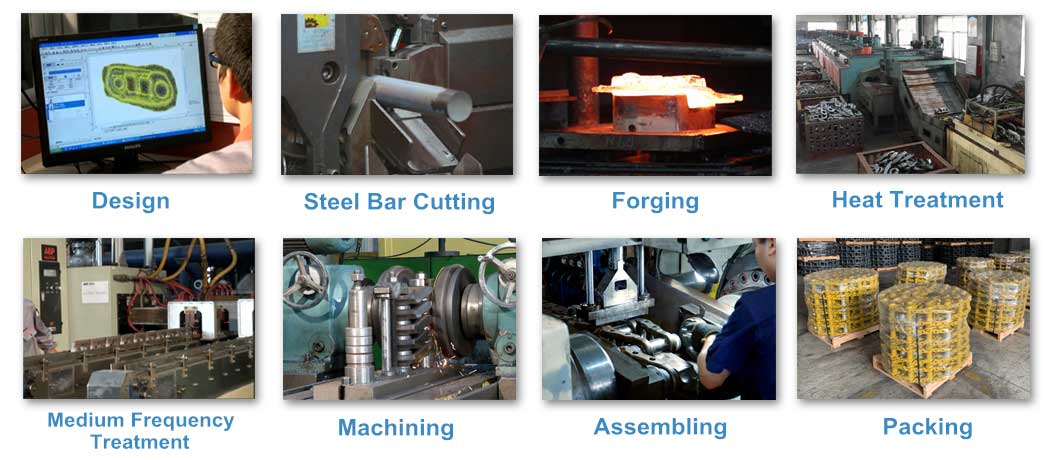
How Does Medium Frequency Heat Treatment Improve Surface Wear Resistance?
Quenching and tempering improve the overall mechanical properties of steel, while medium frequency induction heat treatment can be used to strengthen selected surface areas.
During induction heating, an alternating electromagnetic field generates heat in the metal. The selected surface area is heated rapidly, followed by controlled cooling. This process can create a hardened surface layer while allowing the deeper material to retain different mechanical properties.
For track links, medium frequency heat treatment is particularly relevant to the rail surface, which repeatedly contacts the track rollers during operation. Improving the hardness of this contact area helps the link resist abrasive wear and surface deformation.
Yintparts states that it uses medium frequency heat treatment to enhance the surface wear resistance of its track links. This process works alongside the mesh belt furnace heat treatment used to improve the overall mechanical properties of the component.
For buyers evaluating a sealed and lubricated track link assembly, it is worth checking not only the stated hardness but also the hardened layer depth and the applicable heat treatment requirements.
A high surface hardness reading alone does not prove that the hardened layer is sufficiently deep or that the internal material has suitable toughness.
What Is the Difference Between Surface Hardness and Core Hardness?
Surface hardness and core hardness describe different areas of a heat-treated steel component.
Surface hardness refers to the resistance of the outer material to indentation and localized deformation. For track links, the rail surface needs suitable hardness because it is repeatedly exposed to friction and contact with track rollers.
Core hardness refers to the hardness of the material beneath the hardened surface. The internal material contributes to the component's ability to withstand loads and maintain structural integrity.
A track link with insufficient surface hardness may wear too quickly. On the other hand, a component with unsuitable internal properties may be more vulnerable to impact damage or cracking.
Hardened layer depth is another important factor. It indicates how far the hardened zone extends beneath the surface. If the hardened layer is too shallow for the application, the wearing surface may lose its enhanced properties as material is gradually removed.
For this reason, a reliable track link should have a suitable combination of surface hardness, core properties, and hardened layer depth. These requirements should be determined by the product design and technical specification rather than by one universal hardness value.
Which Steel Materials Are Used for Excavator Track Links?
The steel grade has a direct influence on how a track link responds to heat treatment. Different steel compositions have different hardenability, strength, toughness, and wear resistance characteristics.
Common material selections for track links include alloy steels such as 35MnB, 35MnBH, and 40Mn2. The appropriate material depends on the component design, manufacturing process, machine application, and required mechanical properties.
For example, Yintparts lists 40Mn2 and 35MnB as material options for its excavator and bulldozer track link assembly product. Its bulldozer oil track link product specifies 35MnBH as the raw material.
One product specification should not be treated as a universal requirement for all track links. Buyers should confirm the material grade and heat treatment requirements for the exact machine model and component being purchased.
When sourcing a forged excavator track link and track shoe assembly, it is useful to ask the supplier about the steel grade, heat treatment process, hardness requirements, and available inspection records.
| Material | Typical Consideration | Buyer Check |
|---|---|---|
| 35MnB | Alloy steel used for track link applications | Confirm material grade and heat treatment specification |
| 35MnBH | Material specified for certain lubricated track link products | Check the product drawing and applicable hardness requirements |
| 40Mn2 | Alloy steel listed for certain track link assemblies | Verify compatibility with the component design and application |
How Does Heat Treatment Affect Track Link Service Life?
Proper heat treatment can help extend track link service life by improving resistance to wear and maintaining suitable mechanical properties under repeated loading.
However, actual service life depends on several factors beyond heat treatment. These include the quality of raw steel, manufacturing accuracy, lubrication, track tension, machine weight, ground conditions, and maintenance practices.
For example, a track chain operating in abrasive sand or rocky mining conditions may experience more severe wear than one used on relatively soft soil. Incorrect track tension can also increase contact pressure and accelerate wear in certain areas.
For sealed and lubricated track links, the condition of the seal group and the retention of lubricant are also important. If lubrication is lost or contaminants enter the joint, pin and bushing wear may increase even when the link rail has been properly hardened.
This is why Yintparts identifies several factors affecting oil track link performance, including raw steel quality, rail surface hardness, hardened layer depth, and seal group quality.
When selecting replacement components, buyers should consider the entire track chain assembly rather than evaluating heat treatment as the only factor affecting service life.
How Can Buyers Check Track Link Heat Treatment Quality?
For distributors, repair companies, and construction equipment owners, checking heat treatment quality before purchasing can reduce the risk of receiving components that do not meet the required specifications.
Instead of relying only on general descriptions such as high hardness or wear-resistant steel, buyers should request clear technical information from the manufacturer.
Here are several useful questions to ask before placing an order:
- What steel grade is used for the track link?
- Does the manufacturing process include quenching and tempering?
- Is medium frequency surface heat treatment used for the rail area?
- What surface hardness range is required for this specific product?
- What is the specified hardened layer depth?
- Can the manufacturer provide hardness inspection records?
- Are the dimensions and installation specifications compatible with the target machine model?
Hardness testing can help verify whether a component meets its specified requirements. Depending on the inspection plan, manufacturers may use Rockwell, Brinell, or Vickers testing methods. The selected method and test location should be appropriate for the component and material.
Buyers should also consider dimensional inspection, material traceability, and other quality checks. A hardness result alone cannot confirm every aspect of track link quality.
Why Choose Yintparts for Excavator and Bulldozer Track Links?
Choosing a track link manufacturer involves more than comparing product prices. Buyers also need to consider material selection, forging quality, heat treatment capability, machining accuracy, and quality inspection procedures.
Yintparts manufactures excavator and bulldozer undercarriage components, including track links and track chain assemblies. Its published manufacturing information highlights the use of mesh belt furnace heat treatment, quenching and tempering, and medium frequency surface treatment to improve the mechanical properties and wear resistance of track links.
The company also offers different track link products, including dry track links, sealed and lubricated track links, and track link assemblies for different machine applications.
For customers sourcing replacement bulldozer oil track link assemblies, Yintparts provides product information covering material, heat treatment, dimensions, and applicable machine models.
To confirm the correct product, buyers can provide the machine brand, model, part number, or existing component drawings. This helps the manufacturer check dimensions, installation compatibility, and relevant technical requirements before production.
For a track link that needs to withstand repeated friction and impact, suitable steel material, controlled heat treatment, and consistent quality inspection should all be part of the purchasing decision.
Frequently Asked Questions About Track Link Heat Treatment
How does heat treatment improve the wear resistance of excavator track links?
Heat treatment changes the microstructure and mechanical properties of steel. Quenching and tempering help achieve a suitable combination of hardness and toughness, while medium frequency surface heat treatment can improve the hardness of selected wearing areas. Together, these processes help track links resist surface wear and repeated operating loads.
What is the difference between quenching and tempering for track links?
Quenching involves heating steel and cooling it under controlled conditions to increase hardness and strength. Tempering is performed after quenching to adjust the material's properties, reduce excessive brittleness, and improve toughness. Both processes are important for achieving balanced mechanical performance.
Why is medium frequency heat treatment used on excavator track links?
Medium frequency induction heat treatment can selectively harden the rail surface of a track link. This area repeatedly contacts the track rollers, so improving its surface hardness helps resist abrasion and surface deformation while allowing the deeper material to retain different mechanical properties.
Which steel grades are commonly used for excavator track links?
Alloy steels such as 35MnB, 35MnBH, and 40Mn2 are used in certain track link applications. The appropriate material depends on the product design, manufacturing requirements, and machine application. Buyers should confirm the exact material specification for the selected product.
Does higher track link hardness always mean longer service life?
No. Higher hardness does not automatically guarantee longer service life. A track link also needs suitable toughness, hardened layer depth, dimensional accuracy, and structural integrity. Excessive hardness or unsuitable heat treatment may increase brittleness and the risk of cracking under impact.
How can buyers check the heat treatment quality of track links?
Buyers can request material specifications, heat treatment process information, surface hardness results, hardened layer depth requirements, and inspection records. They should also check dimensions and compatibility with the target machine. Hardness testing should follow an appropriate method and measurement location.
Does heat treatment affect the service life of sealed and lubricated track links?
Yes. Heat treatment helps improve the wear resistance and mechanical properties of the link components. However, the service life of sealed and lubricated track links also depends on pin and bushing quality, seal performance, lubricant retention, operating conditions, and maintenance.